
For years, the answer was simple: if a merchant wanted native B2B on Shopify, Shopify Plus was usually part of the conversation from the start.
That changed in 2026.
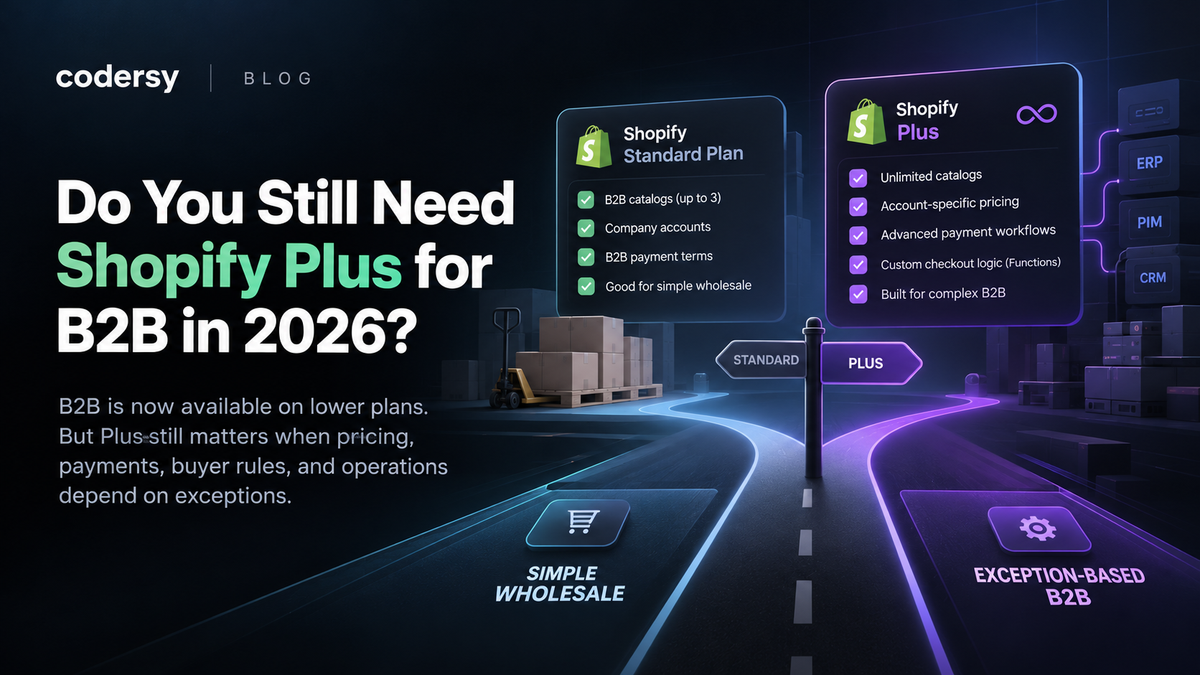
According to Shopify’s B2B changelog, Shopify now gives merchants on Basic, Grow, and Advanced access to native B2B capabilities that were previously much harder to use without Plus.
But this update did not make Shopify Plus irrelevant. It changed when Plus should enter the conversation.
For a simple wholesale channel, a lower Shopify plan may now be enough. For a B2B model where each buyer relationship needs different rules behind the order, the decision becomes less about accessing B2B features and more about controlling the process.
The Short Answer: Not Always
You do not always need Shopify Plus to run B2B on Shopify in 2026.
For many brands, a lower Shopify plan is enough when wholesale works in a predictable way. If most buyers follow the same commercial logic and the team can process orders without constant internal checks, Plus is not automatically justified.
But this is exactly where the evaluation changes.
You do not outgrow lower Shopify plans because you start selling B2B. You outgrow them when exceptions become the primary way your business operates.
The decision to upgrade to Shopify Plus is no longer only about accepting wholesale orders online. It is about whether the business can keep B2B running through a stable system, or whether too much of the process still depends on manual checks, internal fixes, and one-off decisions.
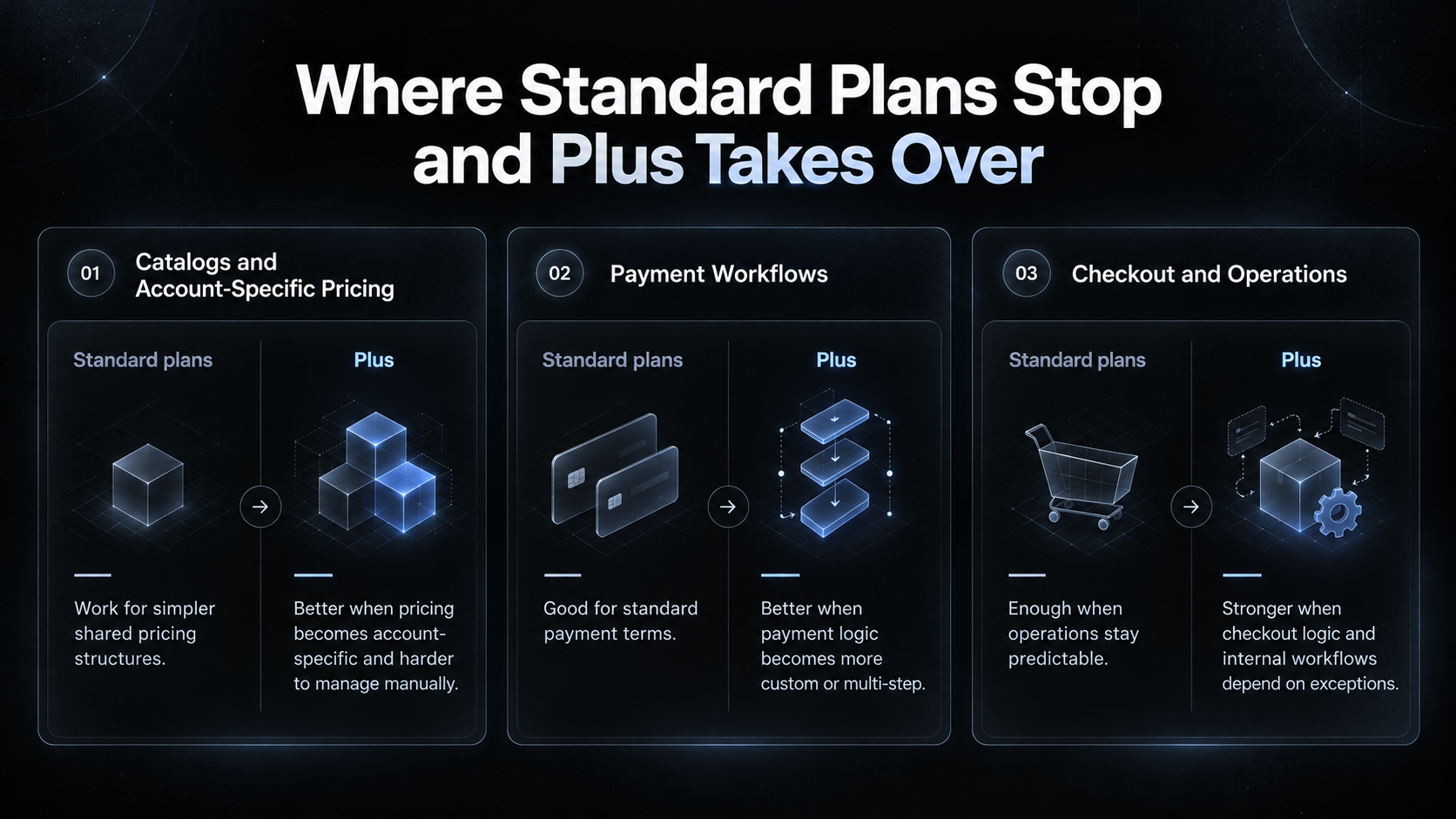
The Core Differences: Where Standard Plans Stop and Plus Takes Over
The difference between standard Shopify plans and Shopify Plus is no longer as simple as “B2B exists here, but not there.”
In 2026, that is the wrong way to look at it. Basic, Grow, and Advanced can support a real B2B channel. The more useful question is where that channel stops being simple enough to manage cleanly.
That line usually appears in three places: how pricing is assigned, how payments are collected, and how much custom logic the business needs around checkout and operations.
Catalogs and Account-Specific Pricing
Catalogs are one of the clearest examples of the new B2B reality.
On standard Shopify plans, catalogs can work well when the business has a small number of clear buyer groups. A merchant might have one catalog for general wholesale buyers, another for distributors, and another for a higher-volume trade group. If the pricing model fits into that kind of structure, a lower plan can be enough.
Shopify Plus starts to matter when catalogs are no longer just buyer groups. They become part of the commercial relationship with each account.
That is a very different situation.
A B2B business might have one key account with negotiated prices, another buyer with location-specific product access, and another with contract terms that do not match any wider customer group. At that point, the issue is not whether Shopify has catalogs. The issue is whether the catalog structure can represent how the business actually sells.
According to Shopify’s B2B features by plan, Basic, Grow, and Advanced are limited to three active B2B catalogs across B2B Markets, while Shopify Plus supports unlimited catalogs and direct catalog assignment to companies and company locations. That difference matters because it changes how precisely the store can reflect real buyer relationships.
The risk with forcing a more complex pricing model into a lower plan is not only inconvenience. It can push the team into awkward workarounds where Markets, tags, manual edits, or separate processes are used to imitate account-specific pricing. That might work for a while, but it becomes harder to maintain as the number of exceptions grows.
This is where the Plus discussion becomes practical. Not because every B2B store needs unlimited catalogs, but because some B2B businesses do not sell through broad groups anymore. They sell through relationships, contracts, and account-level rules.
Payment Workflows Beyond Standard Terms
Payment terms are another area where the difference is easy to underestimate.
For a simple wholesale model, standard payment terms may be enough. A buyer places an order, the order is approved, and payment is due later under a clear agreement. If that reflects how the business already works, there is no need to overcomplicate the setup.
But many B2B businesses do not collect payment in one clean step.
A manufacturer may require a deposit before production starts. A supplier might collect part of the payment before shipping. A large order may need to be paid across fulfillment stages rather than through one simple due date.
This is where Shopify Plus separates itself. Shopify’s plan comparison lists deposits, partial payments, and payment requests per fulfillment as Shopify Plus features. Standard plans can support B2B payment terms, but Plus is where more advanced payment workflows become native to the B2B process.
That difference matters because payment workflow is not just a finance detail. It affects how sales, operations, and fulfillment work together.
Without the right structure, the team may still accept the order online, but then handle the important payment steps outside the system. Someone has to send follow-up emails, track whether the deposit was paid, confirm payment before release, or reconcile the order manually in another tool.
In that case, Shopify is not really controlling the B2B workflow. It is only capturing the order, while the business still manages the commercial process around it.
Custom Logic Around Checkout and Operations
The third difference is custom logic.
This is where merchants often overestimate what a standard setup can do. A lower plan can support native B2B features, Shopify Flow automations, and public apps. For many businesses, that is enough. If the workflow is predictable, the store does not need custom checkout logic to make B2B work.
But there is a difference between automating tasks around an order and changing how the buying process behaves for a specific B2B rule.
Flow can help with operational automation. Public apps can extend parts of the storefront or checkout experience. But when a business needs custom logic built specifically around its own checkout rules, Shopify Plus becomes materially different. Shopify Functions documentation states that stores on any plan can use public apps that contain Shopify Functions, while custom apps using Shopify Function APIs are available only to Shopify Plus stores.
That distinction is important for B2B.
A simple store might not need custom logic at all. A more complex B2B operation might need checkout rules that depend on the buyer, location, order structure, shipping method, tax handling, or internal approval process. When that logic is specific to the business and cannot be handled cleanly through standard settings or public apps, Plus gives the development team more control.
This is also where B2B stops being only a storefront decision.
The store has to connect with how the business actually operates: how prices are approved, how orders are checked, how fulfillment is triggered, and how internal teams avoid manual review. At that point, the question is not whether the merchant can technically take a B2B order on a lower plan. The question is whether the buying process can be trusted without someone fixing exceptions after every order.
Are Your B2B Rules Simple or Exception-Based?
Once the plan differences are clear, the next step is to look at how the B2B process actually works.
A simple B2B setup uses Shopify to standardize buying. Most customers follow the same commercial logic, and the store helps move repeat wholesale orders out of email, draft orders, or manual sales support.
An exception-based setup works differently. The storefront may still capture the order, but the team has to interpret the agreement behind it, check details outside Shopify, or correct the order after it comes in.
That distinction matters more than the plan name.
If Shopify can represent most buyer relationships through a clean, repeatable setup, a lower plan may still be the right fit. If the team keeps fixing what the system cannot model, the business is no longer comparing features. It is dealing with operational strain.
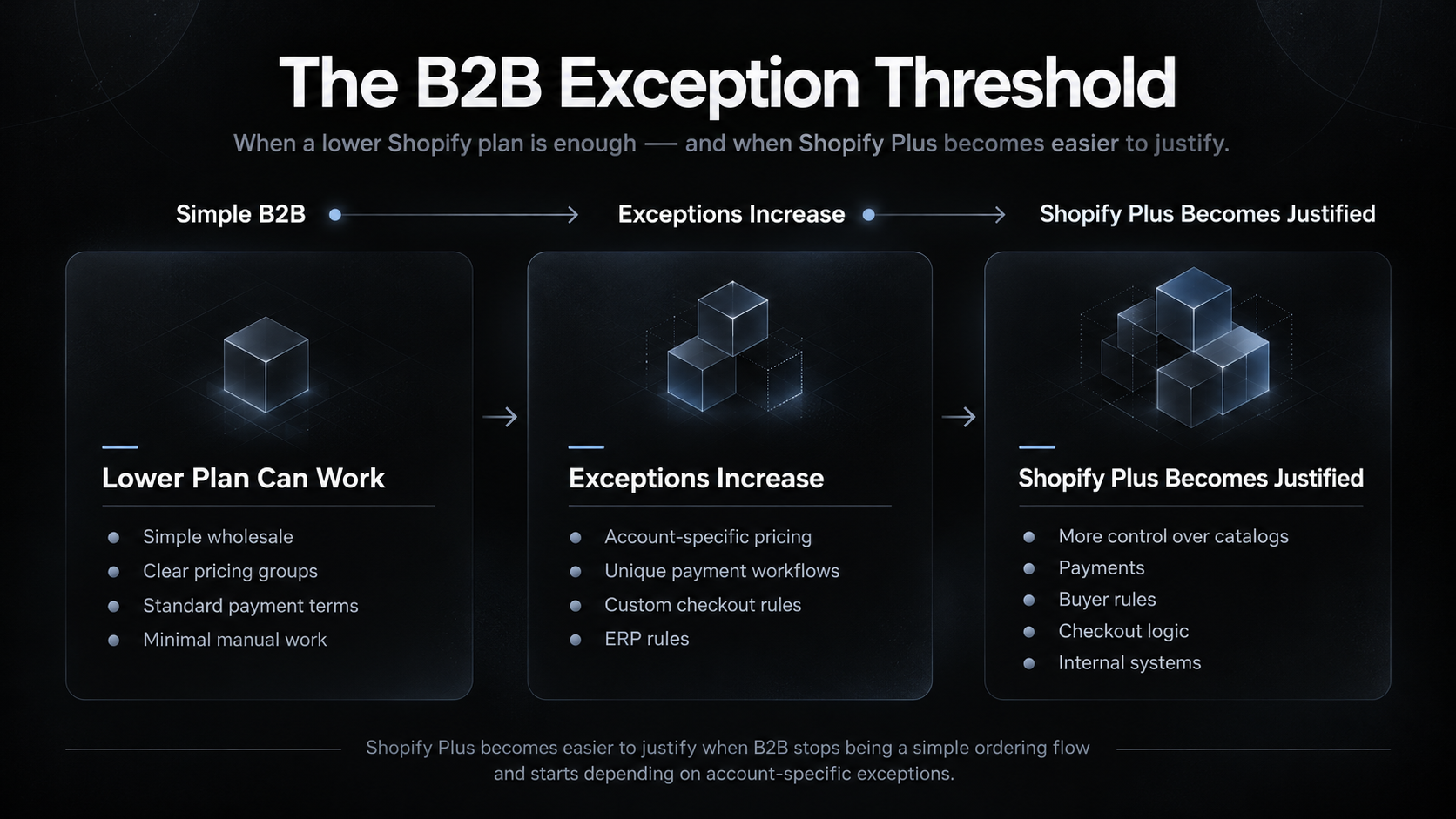
The B2B Exception Threshold
The B2B Exception Threshold is the point where a lower Shopify plan can still take the order, but can no longer model the business cleanly enough behind that order.
This is the most important distinction in the Plus decision.
A merchant does not cross the threshold just because it sells to businesses. It crosses the threshold when the same B2B process cannot apply to most buyers anymore.
| Area | Lower plan can work when... | Plus starts to matter when... |
|---|---|---|
| Pricing | Most buyers fit into a small number of clear pricing groups. | Prices are negotiated by account, contract, location, or long-term buyer relationship. |
| Catalogs | Product access can be handled through a limited number of catalogs. | Different companies or locations need their own product access and commercial terms. |
| Payments | The business uses standard payment terms that apply in a predictable way. | Orders require deposits, partial payments, staged collection, or fulfillment-based payment requests. |
| Operations | Shopify can hold the main B2B rules without much manual review. | The team still needs spreadsheets, internal notes, or manual approvals to process exceptions. |
| Systems | Shopify is the main place where B2B rules are managed. | ERP, finance, inventory, or sales systems control rules that Shopify needs to respect. |
The table is not meant to push every merchant toward Plus. In many cases, it does the opposite.
If most of the answers sit in the left column, Shopify Plus may be premature. The business probably needs a clean B2B implementation first, not a more expensive plan. It can use the lower-plan B2B features to test demand, reduce manual ordering, and give buyers a more professional self-serve experience.
But if the answers keep landing in the right column, the conversation changes. The business is no longer just adding B2B to Shopify. It is trying to make Shopify reflect a more complex commercial model.
At that point, the store may still look like a normal B2B storefront from the outside. Internally, however, the team is managing too many exceptions around it.
That is usually the moment when Shopify Plus becomes easier to justify. Not because the brand has become “enterprise” in a vague sense, but because the B2B workflow needs a stronger system behind it.
What This Looks Like in Practice
The easiest way to understand the Plus decision is to look at the shape of the B2B process, not the size of the business alone.
Two merchants can both “sell B2B” and still need completely different Shopify setups. One may only need a cleaner ordering flow for repeat wholesale buyers. The other may need the store to reflect contracts, account rules, payment exceptions, and data coming from internal systems.
That is why the plan decision should start with how the business actually operates.
Scenario 1: A Lower Plan Is Enough for a Simple Wholesale Channel
Imagine a supplier that sells around 120 packaging products to small retailers, cafes, and local stores.
The products are simple. Buyers usually reorder the same items every month. The business has one clear wholesale model, and most approved buyers follow the same pricing structure. Orders used to come through email, phone calls, or draft orders, but the team mainly wants buyers to log in, see wholesale pricing, and place repeat orders without manual back-and-forth.
In this situation, Shopify Plus would probably not solve the main problem yet.
The main problem is not operational complexity. It is order flow. The business needs to move wholesale buying into a cleaner self-serve experience, reduce manual order entry, and make reordering easier for existing customers.
A lower Shopify plan can make sense here because the rules are still predictable. The team is not creating a different commercial agreement for every large account. The store does not need to represent complicated payment stages, account-specific product access, or custom checkout behavior. It needs to make a simple B2B process more professional and less manual.
That is exactly the kind of merchant that should be careful not to overbuy Shopify Plus too early.
Scenario 2: Shopify Plus Makes Sense When the Business Runs on Exceptions
Now compare that with a distributor selling industrial equipment to dealers, contractors, and regional buyers.
From the outside, it may still look like a normal B2B store. Buyers log in, browse products, and place orders. But behind the storefront, the business works very differently.
Key accounts have negotiated pricing. Some buyers can access products that others cannot. Certain locations follow different commercial terms. Large orders may require deposits before fulfillment starts. The ERP system controls which products are available, which prices are valid, and which customer terms should apply.
In that situation, the problem is no longer just taking B2B orders online.
The store has to reflect the actual relationship between the business and each buyer. If Shopify cannot model that cleanly, the team starts working around the system. Sales reps check prices manually. Operations confirms availability outside Shopify. Finance tracks payment steps in another tool. Support gets involved when buyers see something that does not match their agreement.
This is where Shopify Plus becomes much easier to justify.
Not because the business has reached some vague “enterprise” label, but because the B2B workflow now depends on exceptions that need to be controlled inside the system. At that point, the project is no longer just about opening a B2B storefront. It is about building a B2B setup your team can actually operate, with pricing, buyer access, payment rules, and internal systems structured around the way the business really sells.
A lower plan may still capture the order, but Plus gives the business more room to control the rules behind that order.
The Hidden Cost of Avoiding Plus Too Long
Avoiding Shopify Plus can look like a safe financial decision on paper. If the wholesale model is predictable, staying on a lower plan can protect margin and avoid paying for control the business does not need yet.
The risk appears when the business crosses the exception threshold but continues to force the process into a setup that no longer fits. At that point, the platform cost you avoid is often converted into internal operational drag.
When a B2B channel depends on manual work to handle custom pricing, deposits, split payments, fulfillment checks, or account-specific rules, the real cost moves into the team’s daily workload.
Someone has to reconcile invoices, check pricing spreadsheets, confirm terms, fix order issues, and make sure important buyers are handled correctly. That work can quickly become more expensive than it looks, especially when it slows down fulfillment and increases the risk of mistakes with high-value accounts.
The hidden cost of delaying a Plus upgrade is not only manual labor. It is the bottleneck on your capacity to scale. If the sales and operations teams are spending their time keeping current accounts running through workarounds, they have less capacity to onboard new distributors, improve buyer experience, or grow the channel.