
If you have ever asked “what percentage does Shopify take per sale?”, the answer is: it depends on how your store accepts payments.
Shopify does not take the same fixed percentage from every sale. The main thing to understand is the difference between payment processing fees and third-party transaction fees.
If you use Shopify Payments, you still pay payment processing fees, but Shopify does not add an extra third-party transaction fee on eligible orders. If you use an external payment provider, Shopify can charge an additional transaction fee on top of whatever your provider already charges.
So the real question is not only how much Shopify takes. It is whether your payment setup makes sense for your margins, checkout, and market.
Does Shopify Take a Percentage of Every Sale?
Shopify can take a percentage of a sale, but not in the same way for every store.
In practice, your fees depend on your Shopify plan, payment provider, store location, and whether you use Shopify Payments or a third-party payment gateway.
There are two main costs to understand.
- Payment processing fees are charged for processing online payments. If a customer pays by card or another online method, that payment needs to be authorized, processed, and settled. This cost exists on every ecommerce platform, not just Shopify.
- Third-party transaction fees are different. These are additional Shopify fees that can apply when you use an external payment provider instead of Shopify Payments.
So the more accurate answer is:
Shopify does not automatically take the same percentage from every sale. You pay payment processing fees either way, but additional Shopify transaction fees usually depend on your payment setup.
Two Shopify stores with the same revenue can have different costs per order. One store may use Shopify Payments and avoid additional third-party transaction fees. Another may use an external provider because of local payment methods, market needs, or accounting requirements.
Neither setup is automatically right or wrong. What matters is knowing what each one actually costs.
Shopify Payments vs. Third-Party Payment Providers
The payment provider you choose directly affects how much Shopify costs per sale.
Shopify Payments is Shopify’s own payment solution. Third-party payment providers are external gateways or payment services that connect to your Shopify store.
The main difference is simple:
Shopify Payments can help you avoid additional third-party transaction fees on eligible orders. An external payment provider can add another cost, because you may pay both the provider’s fee and Shopify’s additional transaction fee.
When you use Shopify Payments, your store can process payments directly through Shopify. Shopify does not charge additional third-party transaction fees on eligible orders processed through Shopify Payments, according to the Shopify payments page.
But Shopify Payments is not available in every country, and not every business is eligible. Some merchants need local payment providers, B2B payment terms, regional gateways, or payment methods customers already trust in a specific market.
When you use an external provider, that provider can charge its own processing fee. On top of that, third-party transaction fees can apply when a merchant uses an external payment provider instead of Shopify Payments, according to Shopify’s information page about third-party transaction fees.
That is why payment setup should not be chosen only by looking at the lowest advertised rate. You need to look at the full picture: fees, market fit, checkout conversion, refund rate, and operational needs.
What Percentage Does Shopify Take Per Sale?
The percentage Shopify takes per sale depends mainly on your Shopify plan and payment provider.
If you use Shopify Payments, you pay the payment processing rate for your plan and location. If you use a third-party payment provider, Shopify can charge an additional transaction fee on top of your provider’s fee.
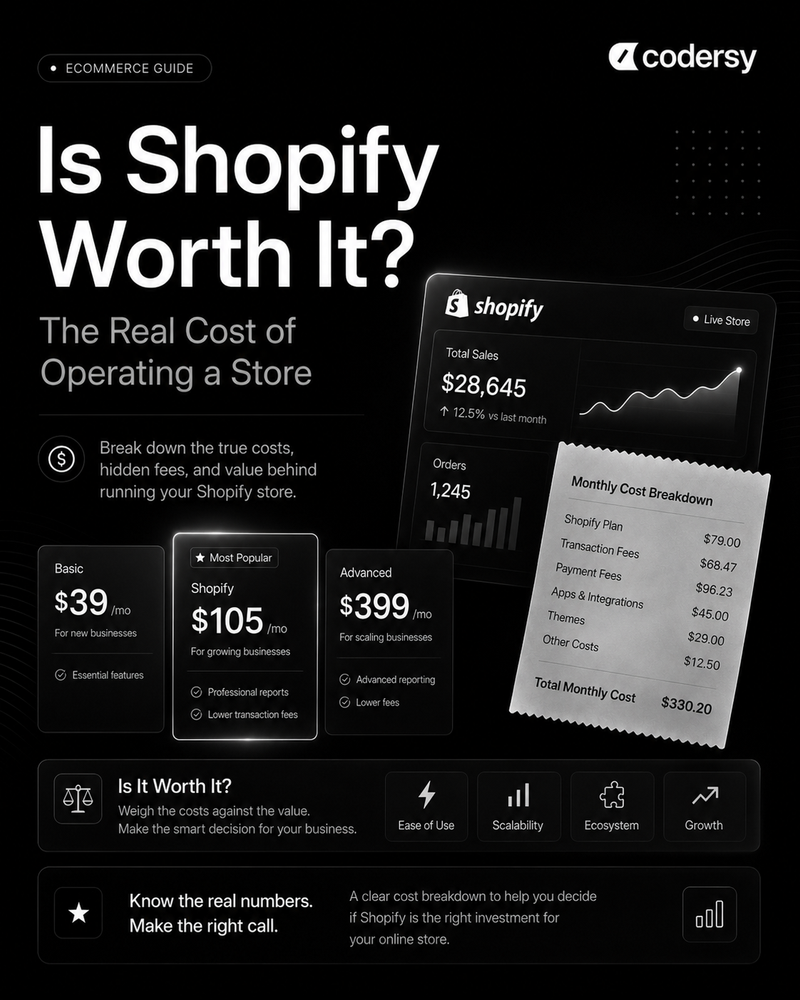
| Shopify plan | Third-party transaction fee | Online card rate shown on Shopify pricing page |
|---|---|---|
| Basic | 2% | From 2.1% + €0.30 |
| Grow | 1% | From 1.8% + €0.30 |
| Advanced | 0.6% | From 1.6% + €0.30 |
| Plus | Custom / best rates | From 1.3% + €0.30 |
These rates should always be checked on the official Shopify pricing page, because pricing can vary by store location, currency, plan, and current Shopify terms.
For a small store, the difference between 2% and 1% may not feel urgent. For a store processing $100,000 per month, that 1% difference can mean $1,000 per month before app costs, shipping, refunds, taxes, or development work.
So the real question is not only how much Shopify takes per sale.
The better question is:
Which Shopify plan and payment setup gives you the best balance between fees, conversion, operational control, and long-term growth?
Shopify Transaction Fees Are Not the Same as Credit Card Fees
This is where most of the confusion happens.
A credit card fee is the cost of processing the customer’s card payment. The payment has to be authorized, processed, and paid out. That service costs money.
A Shopify transaction fee is different. It is an additional fee Shopify may charge when you use a third-party payment provider instead of Shopify Payments.
So when you look at Shopify costs, you need to ask:
Is this a payment processing fee, or is this an additional Shopify transaction fee?
For example, if you sell a product for $100 and use Shopify Payments, you pay the relevant processing fee for your plan and region. If you use a third-party provider, the provider may charge its own fee, and Shopify may also add a transaction fee based on your plan.
That means two stores can process the same $100 order and keep different amounts after fees.
The goal is not to find the cheapest payment setup on paper. The goal is to build a setup that protects margin without making checkout harder for customers.
Example: How Shopify Fees Work on a $100 Order
Imagine a customer places a $100 order in your Shopify store.
If the order is processed through Shopify Payments, the simplified structure looks like this:
$100 order − Shopify Payments processing fee = amount after payment cost
If the store uses an external payment provider, the structure looks like this:
$100 order − provider processing fee − Shopify third-party transaction fee = amount after payment cost
If your plan has a 2% third-party transaction fee, that is $2 on a $100 order before you even count the payment provider’s own processing fee.
On one order, that may not sound like much. Across 1,000 orders, it becomes $2,000 in additional transaction fees, before other costs are included.
That is why payment setup should not be treated as a small admin setting. It directly affects margin.
What Happens With Refunds and Manual Payments?
Refunds are another area where merchants often miscalculate costs.
When you refund an order, it does not always mean the original fees are returned. Third-party transaction fees are not returned when an order is refunded, based on Shopify’s third-party transaction fees documentation.
This matters for stores with high return rates, because a refunded order can still cost the business money.
On the other hand, not every Shopify order is paid by card. Some stores use cash on delivery, bank transfers, deposits, or custom payment instructions.
Shopify does not charge third-party transaction fees on manual payment methods such as cash, cash on delivery, bank deposits, checks, test orders, and draft orders marked as paid or pending, based on Shopify’s manual payment methods.
Still, manual payments have tradeoffs. They can reduce online payment fees, but they often create more operational work: checking bank transfers, managing unpaid orders, dealing with failed COD deliveries, and keeping order statuses clean.
The cheapest payment method on paper is not always the best one in practice.
What About Shopify Plus?
Shopify Plus is a different conversation.
For smaller stores, the question is often: “How much does Shopify take per sale?” For larger or more complex ecommerce businesses, the question becomes wider:
Does our Shopify setup support the way the business actually needs to sell?
That includes payment fees, but also checkout control, B2B workflows, international markets, staff permissions, automation, integrations, and operational complexity.
Shopify Plus can make sense when a store needs:
- more advanced checkout customization,
- B2B or wholesale workflows,
- multi-market selling,
- custom integrations,
- stronger operational flexibility,
- a more scalable ecommerce architecture.
For stores at that stage, Shopify Plus store development is not just about building a better-looking storefront. It is about creating a setup where checkout, payments, integrations, and operations work together without slowing growth down.
Shopify Plus should not be judged only by its monthly price.
A more expensive plan can make sense if it reduces operational friction, supports better conversion, gives the business more payment flexibility, or unlocks features that cannot be handled properly on a lower plan.
But a store should not move to Shopify Plus just because it sounds more advanced. The decision should depend on order volume, margins, payment setup, checkout needs, and the level of custom development the business actually needs.
How to Reduce Shopify Fees Without Hurting Checkout
Reducing Shopify fees sounds simple: choose the cheapest payment setup and move on.
In practice, that can be a bad decision.
Payment fees matter, but checkout conversion matters too. If a cheaper setup removes a payment method customers trust, slows checkout down, or increases failed payments, the store can lose more money than it saves.
A better way to review payment setup is to ask:
- Does Shopify Payments support your market and operations?
- Does every payment method in checkout have a clear reason to exist?
- Does your current Shopify plan still make sense as revenue grows?
- Is checkout still fast, clear, and easy for the customer?
More payment options do not automatically mean a better checkout. Each method should improve trust, support a specific market, increase conversion, or make operations easier.
The same applies to Shopify plans. A lower monthly subscription can look cheaper, but if your store has enough order volume, higher per-sale fees can cost more than upgrading to a stronger plan.
A good payment setup is not the one that saves a small percentage at any cost. A good payment setup helps customers complete the order and helps the business keep more profit after the order is processed.
So, Does Shopify Take a Percentage of Sales?
Yes, Shopify can take a percentage of sales, but the full answer depends on your payment setup.
If you use Shopify Payments, you still pay payment processing fees, but Shopify does not add extra third-party transaction fees on eligible orders.
If you use a third-party payment provider, Shopify can charge an additional transaction fee on top of the provider’s processing fee. That fee depends on your Shopify plan and setup.
The most accurate answer is:
Shopify fees depend on your plan, payment provider, store location, and the payment method your customer uses.
For a small store, the difference may be manageable. For a high-volume store, the wrong payment setup can quietly reduce profit every month.
Shopify fees are not just a technical detail. They affect pricing, margin, checkout, refunds, and long-term scalability.
FAQs About Shopify Sales Fees
Does Shopify take a cut of every sale?
Shopify can take a percentage of a sale, but it depends on the payment method and setup.
If you use Shopify Payments, you pay a payment processing fee, but Shopify does not add an extra third-party transaction fee on eligible orders. If you use a third-party payment provider, Shopify can charge an additional transaction fee.
What percentage does Shopify take per sale?
The percentage depends on your Shopify plan, payment provider, and store location.
With third-party providers, Shopify transaction fees can vary by plan. With Shopify Payments, the main cost is the payment processing rate, not an additional third-party transaction fee on eligible orders.
Are Shopify transaction fees and payment processing fees the same?
No. A payment processing fee is the cost of processing the customer’s payment.
A Shopify transaction fee is an additional fee Shopify can charge when you use a third-party payment provider instead of Shopify Payments.
Does Shopify refund transaction fees?
In many cases, no.
When you refund an order, the original payment or transaction fees are not always returned to the merchant. That means refunded orders can still create costs for the business.
Is Shopify Plus cheaper for high-volume stores?
Shopify Plus can be more cost-effective for some high-volume stores, but not automatically.
It usually makes sense when the business needs better rates, more checkout control, B2B features, international selling, custom integrations, or a more scalable ecommerce setup.