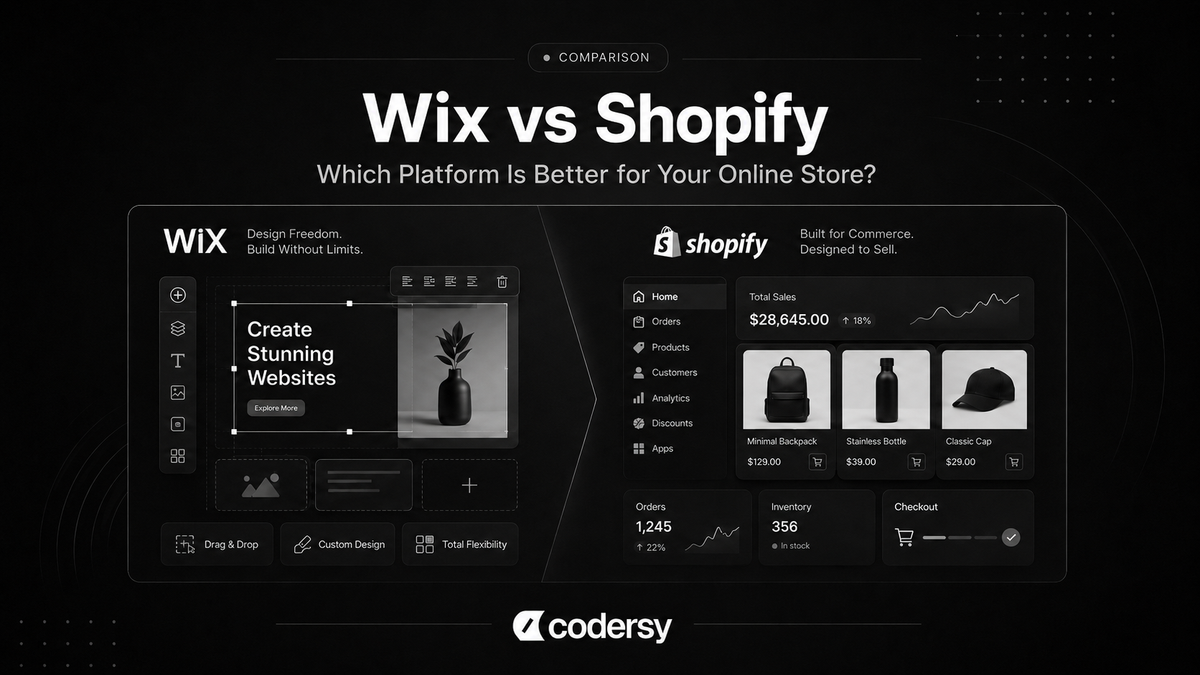

Choosing between Wix and Shopify depends on what you are trying to build. Both platforms can help you create an online presence, but they are not built around the same primary use case.
Wix is usually a better fit when you need a flexible business website, portfolio, service site, or smaller online store where ecommerce is only one part of the site. Shopify is often the better fit when selling products is the core of the business and the store needs stronger ecommerce tools, checkout, payments, inventory, shipping, and sales channels.
So the question is not only “Wix or Shopify?”
The better question is: are you building a website that also sells, or an online store that needs to grow?
If you need a simple website with light ecommerce, Wix can be enough. If selling products is the main goal, Shopify is usually the more practical platform to build around.
What Is Wix?
Wix is a website builder that helps users create websites with templates, design tools, business features, and ecommerce options.
It can work well for service businesses, portfolios, local businesses, personal brands, restaurants, small shops, and businesses that need a website first and online selling second.
Wix describes its platform as a website builder with templates, AI tools, business features, and custom domain options, based on Wix’s website builder page.
For many users, Wix’s main appeal is flexibility. You can build pages visually, adjust layouts, add content, and create a website without needing a developer for every small change.
That does not mean Wix cannot support ecommerce. It can. But for this comparison, the important point is that Wix starts from a broader website-building angle.
What Is Shopify?
Shopify is an ecommerce platform built for creating and managing online stores.
It brings products, inventory, payments, checkout, orders, shipping, analytics, apps, and sales channels into one commerce-focused platform. Shopify describes itself as an all-in-one commerce platform for creating an online store, accepting payments, and selling across different channels, according to Shopify’s product page.
For businesses where selling products is the main focus, Shopify often gives a cleaner ecommerce workflow than a general website builder.
Store owners can manage product pages, collections, discounts, checkout, payments, shipping settings, apps, and order operations from the same platform.
That is why Shopify is often the stronger fit when the business needs more advanced ecommerce workflows than a simple website setup. It is built around the day-to-day work of running an online store.
Wix vs Shopify: Quick Comparison Table
| Area | Wix | Shopify |
|---|---|---|
| Best for | Business websites, portfolios, service sites, and smaller stores | Ecommerce-first stores and growing product businesses |
| Main strength | Visual website building and design flexibility | Ecommerce operations, products, checkout, orders, and sales channels |
| Ease of use | Easier for simple websites and visual editing | Easier for managing store operations once ecommerce becomes the focus |
| Design | Flexible drag-and-drop website editing | Theme-based storefront design with ecommerce structure |
| Ecommerce | Good for simpler selling needs | Stronger for product catalogs, inventory, checkout, and scaling |
| SEO | Good for basic website SEO | Stronger fit for ecommerce SEO workflows |
| Apps and integrations | Broad business and website tools | Commerce-focused apps and integrations |
| Scaling | Better for simpler websites and smaller selling setups | Better fit for stores that expect more ecommerce growth |
This table gives the basic difference, but the right choice depends on how the business will actually use the platform.
Ease of Use: Which Platform Is Easier?
The easier platform depends on what you are trying to build.
Wix is often easier for users who want to create a website visually. Its editor is built around page design, layout control, content sections, and simple site management. That can make it comfortable for service businesses, local brands, freelancers, restaurants, personal brands, or small companies that want to manage a website without touching code.
Shopify is also beginner-friendly, but it is more focused on store management than general website building.
If you are adding products, managing collections, setting up payments, handling orders, creating discounts, connecting apps, or preparing shipping rules, Shopify usually feels more natural because those workflows are central to the platform.
So if you are deciding between Wix or Shopify, the easier option depends on the job:
- Wix is usually easier for building a simple website.
- Shopify is usually easier for running an online store.
That distinction matters.
A platform can be easy for design but weaker for ecommerce operations. Another platform can feel more structured at first but become easier once the business starts managing products, orders, inventory, and sales channels every day.
Ecommerce Features: Which Platform Is Better for Selling?
This is where the difference between Wix and Shopify becomes clearer.
Wix can work well when ecommerce is one part of a broader website. For example, a small business might sell a few products, digital items, bookings, event tickets, or simple merchandise while still using the website mainly for brand presence, services, content, or local visibility.
Shopify often becomes stronger when selling products is the main purpose of the website.
The platform is built around ecommerce workflows such as:
- product pages,
- collections,
- inventory,
- checkout,
- payments,
- shipping,
- discounts.
That does not mean every business needs Shopify from day one. A very small store with a simple catalog may not need a more commerce-focused setup immediately.
But once the business starts caring more about product structure, conversion, checkout experience, order operations, product feeds, inventory, and growth, Shopify often becomes the more practical choice.
The difference between Wix and Shopify is not only about whether both platforms can sell products. Both can.
The better question is how much of the business depends on ecommerce.
Design and Customization
Wix and Shopify also approach design in different ways.
Wix gives users more visual freedom when building pages. It is often easier to move sections around, adjust layouts, create landing pages, and design a website that feels less restricted by ecommerce structure.
Shopify uses a theme-based approach. That can feel more structured, but the structure exists for a reason: ecommerce pages need consistency across products, collections, carts, checkout paths, navigation, mobile layouts, and merchandising sections.
When comparing Wix vs Shopify customization, the main difference is this:
- Wix gives more visual control for general website design.
- Shopify gives more structured customization for ecommerce storefronts.
Shopify can also be customized through themes, custom sections, apps, integrations, and custom development. So the platform is not limited to basic templates. But the customization usually works best when it supports the ecommerce experience, not when every page is treated as a completely separate design project.
Wix vs Shopify for SEO
Wix and Shopify can both support SEO, but they are usually used in different types of projects.
Wix can work well for websites where SEO depends on service pages, location pages, blog content, landing pages, and general website structure. Wix lets users customize SEO basics such as title tags and meta descriptions, based on Wix’s SEO settings documentation.
Shopify is usually a stronger fit when SEO depends heavily on ecommerce structure. That includes product pages, collections, internal linking, redirects, product content, category content, and technical cleanup across a growing catalog.
Shopify also provides SEO guidance for online stores, including how to optimize on-page elements like product titles and meta descriptions, based on Shopify’s SEO overview documentation.
So the question is not only whether Wix or Shopify can be optimized for search. Both can.
The better question is what kind of SEO work the business will need.
If SEO is already important to the business, a Shopify SEO audit can help review structure, technical issues, redirects, collections, product pages, and migration risks before moving platforms.
If Shopify becomes the better fit and organic traffic is part of the growth plan, a Shopify SEO checklist can also help review the technical and on-page basics before scaling the store.
Pricing and Total Cost
Pricing should not be judged only by the monthly plan.
Wix and Shopify both have subscription plans, but the real cost depends on what the business needs: ecommerce features, apps, payment processing, design work, integrations, and future development.
Wix can look more approachable for businesses that need a website first and ecommerce second. Its paid plans include different levels of storage, business features, and ecommerce support, according to Wix’s pricing page.
Shopify pricing is more directly tied to ecommerce operations. Its plans include monthly fees, card rates, and third-party transaction fees depending on the plan and payment setup, based on Shopify’s pricing overview.
That does not mean one platform is automatically cheaper than the other.
Wix may be more cost-effective for a simple website with a small selling component. Shopify may be easier to justify when ecommerce is expected to become a larger part of revenue.
The total cost can include:
- the monthly platform plan,
- paid apps,
- premium templates or themes,
- payment processing,
- third-party transaction fees,
- custom design work,
- integrations.
Apps, Integrations, and Growth
Both Wix and Shopify can be extended with apps and integrations.
The difference is usually the type of growth each platform supports better.
Wix has a broader website and business focus. Its ecosystem can support websites that need forms, bookings, events, content, marketing tools, simple ecommerce, and general business features.
Shopify’s ecosystem is more commerce-focused. It is usually stronger when the store needs tools for products, checkout, upsells, reviews, subscriptions, fulfillment, analytics, email marketing, inventory, and ecommerce operations.
This matters because apps are not just “extra features.”
They can shape how the business sells, tracks customers, manages orders, and improves conversion.
For a smaller website, a few simple apps may be enough. For a growing online store, the business may need stronger ecommerce integrations that connect product data, order management, customer data, marketing, shipping, and reporting.
This is where Shopify can become the more practical option for stores that expect to grow beyond a simple product setup.
Wix can still work well for simpler business needs. But when apps and integrations become part of the store’s growth system, Shopify usually gives teams a more ecommerce-focused foundation.
When Wix Makes More Sense
Wix can make more sense when the business needs a website first and ecommerce second.
It is often a good fit for businesses that need a clean online presence, service pages, portfolio pages, booking options, contact forms, blog content, and a simple way to manage website updates.
Wix may be the better choice if the business needs:
- a service-based website,
- a portfolio or personal brand site,
- a local business website,
- restaurant, booking, or event pages,
- a smaller product catalog,
- simple online selling,
- more visual design control,
- and less ecommerce complexity.
In these cases, the website usually has more jobs than just selling products.
It needs to present the business, explain services, show examples of work, collect leads, support bookings, and give visitors a clear reason to trust the brand.
The main limitation appears when the store side becomes more important. If the business starts needing deeper product organization, stronger checkout flows, more advanced inventory, more ecommerce apps, or better scaling around product sales, Wix may start to feel less practical.
When Shopify Makes More Sense
Shopify can make more sense when ecommerce is the main business model.
If the goal is to sell products, manage orders, improve checkout, organize inventory, connect sales channels, and scale ecommerce operations, Shopify usually gives the business a stronger foundation.
Shopify may be the better choice if the business needs:
- product-focused pages,
- organized collections,
- checkout and payment workflows,
- inventory management,
- discount and promotion tools,
- shipping settings,
- ecommerce apps and integrations,
- multi-channel selling,
- and room to grow beyond a small catalog.
This is where Shopify’s structure becomes useful.
A business that sells products every day needs more than a good-looking website. It needs a system that can support product updates, campaigns, order management, customer journeys, and future growth.
If the business is moving from a simple website into a serious ecommerce operation, a custom Shopify store build can be a cleaner path than forcing a general website setup to act like a full online store.
That does not mean every business should choose Shopify immediately.
But if ecommerce is already important, or expected to become important, Shopify is usually the more practical platform to build around.
Final Verdict: Wix or Shopify?
The best choice depends on what the business is trying to build.
Wix is usually the better fit for businesses that need a flexible website with lighter ecommerce needs. It works well when the site is mainly about services, content, bookings, local visibility, portfolios, or a smaller product setup.
Shopify is usually the better fit when ecommerce is the main focus. It gives the business a stronger structure for products, checkout, payments, orders, inventory, shipping, apps, and long-term store growth.
So the final decision is not really about which platform is “better” in general.
It is about what matters more for your business right now:
| If you need... | The better fit is usually... |
|---|---|
| A simple business website | Wix |
| A portfolio, service site, or local website | Wix |
| Light ecommerce on a broader website | Wix |
| A product-focused online store | Shopify |
| Stronger checkout, inventory, and order workflows | Shopify |
| More room for ecommerce growth | Shopify |
Wix can be enough when the store is only one part of the website.
Shopify makes more sense when the website needs to operate as a real ecommerce business.
FAQs About Wix vs Shopify
Is Wix or Shopify better?
Wix is usually better for simple websites, service businesses, portfolios, and smaller stores with lighter ecommerce needs.
Shopify is usually better when online selling is the main focus and the business needs stronger tools for products, checkout, orders, inventory, and growth.
What is the main difference between Wix and Shopify?
The main difference between Wix and Shopify is that Wix is more website-first, while Shopify is more ecommerce-first.
Wix focuses more on building flexible websites. Shopify focuses more on running online stores.
Is Wix or Shopify better for SEO?
Both platforms can support SEO.
Wix can work well for simpler websites, service pages, local pages, and blog content. Shopify is often a better fit when SEO depends on product pages, collections, ecommerce structure, redirects, and a growing catalog.
Can I move from Wix to Shopify later?
Yes, a business can move from Wix to Shopify later, but the migration should be planned carefully.
Products, pages, URLs, redirects, SEO metadata, images, and tracking should be reviewed before moving, especially if the existing Wix site already gets organic traffic or sales.