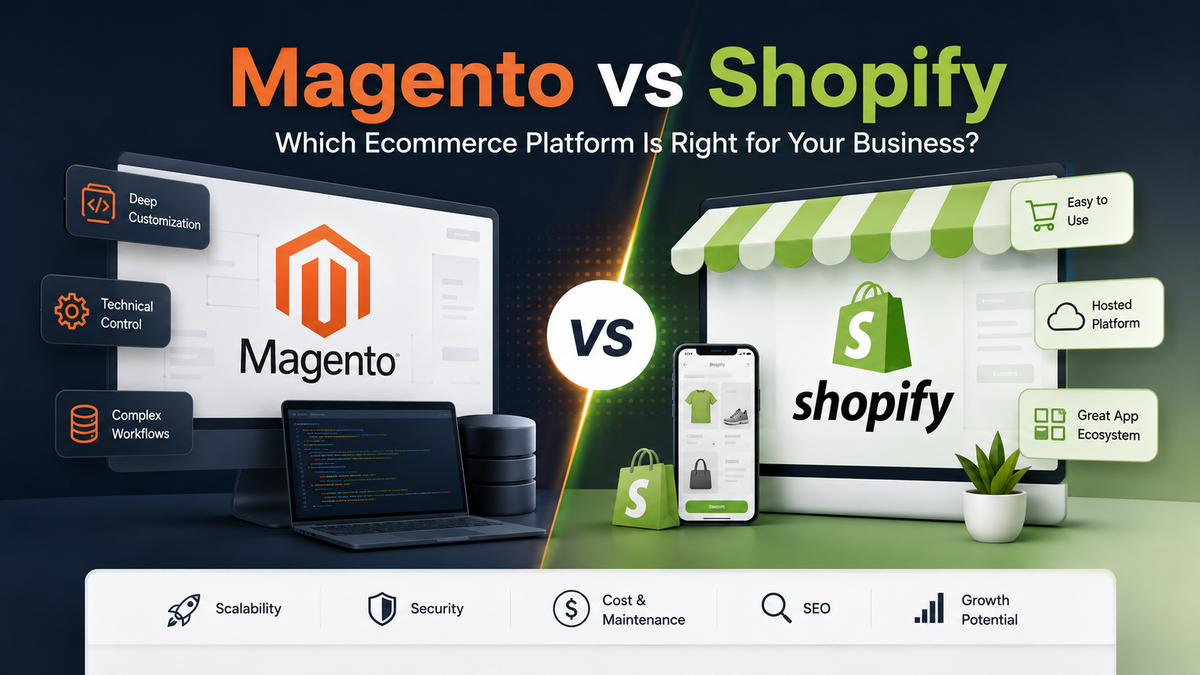

Magento vs Shopify: The Short Answer
Quick answer: Shopify is often the more practical choice for ecommerce brands that want easier setup, lower maintenance, and a simpler day-to-day workflow. Magento can make more sense for businesses that need deeper technical control, custom backend logic, and have the team or budget to maintain it properly.
Choosing between Magento and Shopify is not about which platform is “better” in general. It is about which one fits your business model, technical resources, budget, and growth plans.
Magento can give businesses more control, especially when the store needs deep customization and a team that can manage the technical side. Shopify, on the other hand, often gives teams a more manageable setup by bringing hosting, checkout, updates, and many day-to-day ecommerce features into one platform.
So the real question is not only “Magento or Shopify?”
The better question is: which platform lets your ecommerce team grow without creating unnecessary technical weight?
Choose Magento if you need deep technical control and have the team to support it.
Choose Shopify if you want a faster, more manageable ecommerce setup that lets your team focus more on growth than platform maintenance.
What Is Shopify?
Shopify is a hosted ecommerce platform that lets businesses build and manage an online store without running their own server infrastructure.
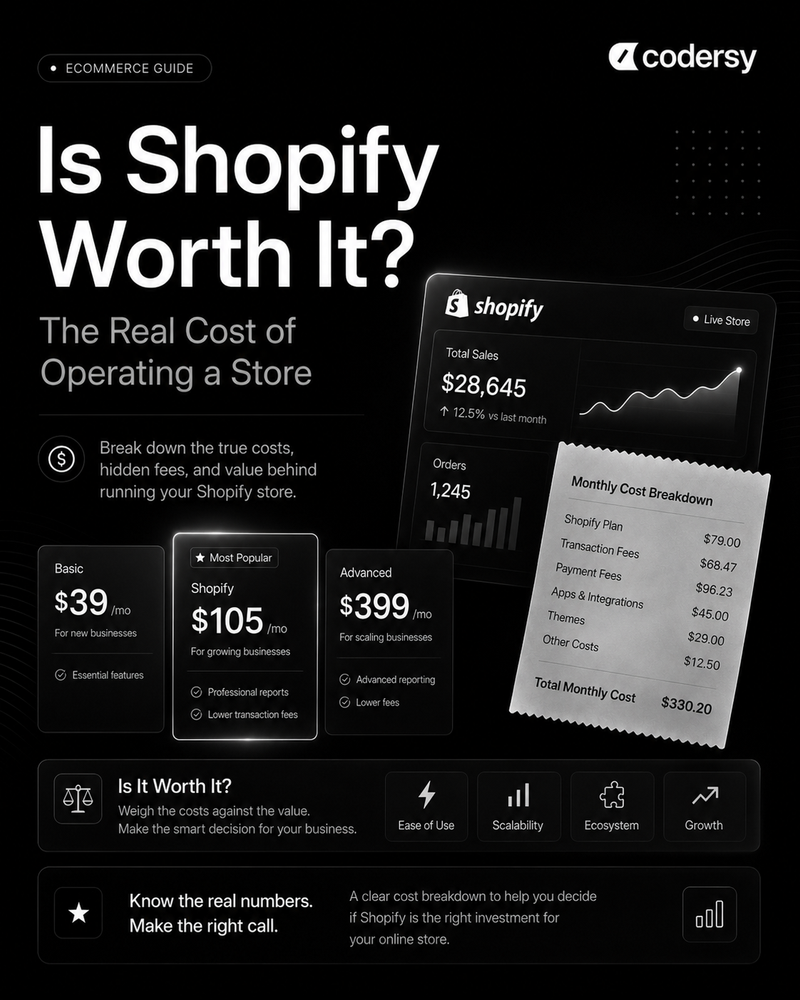
Store owners can manage products, orders, payments, themes, apps, and sales channels from one admin. Shopify’s plans are structured by subscription tier, based on Shopify’s official pricing page.
For many businesses, Shopify’s main advantage is operational simplicity. The team can spend less time managing hosting, updates, and backend maintenance, and more time improving customer experience, marketing, merchandising, and growth.
Shopify can also be extended through themes, apps, integrations, custom development, and Shopify Plus for more advanced needs. Compared to Magento, it is often easier for non-technical teams to launch, maintain, and manage day to day.
What Is Magento?
Magento is an ecommerce platform often associated with flexibility, customization, and deeper technical control.
Today, it is important to separate Magento Open Source from Adobe Commerce. Magento Open Source is positioned as an ecommerce platform for small and mid-sized businesses, based on Adobe’s Magento Open Source page. Adobe Commerce is often a better fit for businesses with more complex commerce needs, such as B2B workflows, larger catalogs, or multi-market selling.
Magento can make sense when a business needs complex product structures, custom backend workflows, or more control over how the ecommerce system is built. But that flexibility usually comes with more technical ownership.
A Magento store often needs more attention around hosting, performance, security updates, extensions, development quality, and ongoing maintenance. That does not make Magento a bad platform. It makes it more demanding.
Magento vs Shopify: Main Differences
Magento and Shopify can both support serious ecommerce stores, but they work in very different ways.
In practice, Shopify often reduces technical complexity, while Magento gives more control to teams that can handle that complexity.
Setup and Ease of Use
Shopify is usually easier to set up and manage.
Because it is hosted, the team does not need to manage servers, hosting configuration, security patches, or core platform updates in the same way as with an open-source setup.
This can make Shopify more accessible for business owners, marketing teams, ecommerce managers, and smaller teams that want to move quickly.
Magento is more technical from the start. It gives more freedom, but it also requires more setup, more development knowledge, and more ongoing technical management.
For businesses without a reliable developer or technical team, that can become a serious bottleneck.
Customization and Flexibility
Magento gives more deep technical control.
If a business needs a highly custom backend setup, unusual product logic, complex workflows, or very specific infrastructure control, Magento can be a strong option.
Shopify is more structured, but that does not mean it is basic. It can be customized through themes, apps, custom integrations, and Shopify Plus.
For many brands, that is enough flexibility without the same maintenance burden.
The real question is not which platform can be customized more.
The real question is how much customization the business actually needs, and whether the team can maintain it long term.
Cost and Maintenance
Shopify often has more predictable platform costs because the main subscription plans are clearly listed by tier.
But Shopify costs are not only the monthly plan. The total cost can also include:
- paid apps,
- custom development,
- theme work,
- integrations,
- payment processing fees,
- and third-party transaction fees when using an external payment provider instead of Shopify Payments.
Third-party transaction fees may apply when a store uses a third-party payment provider instead of Shopify Payments, according to Shopify’s documentation on third-party transaction fees.
Magento Open Source may look cheaper at first because there is no standard monthly platform subscription in the same way. But the cost usually moves into other areas, such as:
- hosting,
- development hours,
- performance optimization,
- extensions,
- security patches,
- server maintenance,
- and ongoing technical support.
Adobe publishes security patch release notes for Adobe Commerce, which is a good reminder that security updates are part of the long-term maintenance responsibility, based on Adobe’s security patch release notes.
So the cost comparison is not only monthly subscription vs. free platform. It is total cost of ownership.
A cheaper platform on paper can become expensive if it requires constant technical work, while a more structured platform can be easier to budget for if the team wants fewer infrastructure responsibilities.
Apps, Extensions, and Integrations
Shopify can be easier to extend through apps when a store needs extra features without building everything from scratch. Many stores use apps for marketing, design, fulfillment, reviews, subscriptions, analytics, and customer support, depending on what the business needs.
Magento also has extensions and can support very custom integrations, but those often need more technical review before installation and more maintenance after launch.
With either platform, too many apps or extensions can create problems.
The best setup is not the one with the most tools. It is the one where every app, extension, and integration has a clear purpose and does not slow the store down or create operational issues.
Which Platform Is Better for SEO?
Both Magento and Shopify can work well for SEO, but they give teams a different level of control.
Shopify is often easier for basic SEO management. You can manage titles, meta descriptions, product URLs, collections, redirects, image alt text, and blog content without heavy technical work.
The tradeoff is that Shopify is more structured. Shopify uses clean URL patterns such as /products/[product-handle] and /collections/[collection-handle], based on Shopify’s guide to SEO URL structure.
That matters because Shopify products can sometimes be reached through different collection paths. In those cases, the SEO setup needs to make sure Google understands the preferred product URL.
Magento can give teams more control over technical SEO, especially on larger stores with complex category structures, filtering, and custom URL requirements. That flexibility can be useful for advanced SEO setups, but it also means the team needs to manage things like crawl paths, duplicate URLs, faceted navigation, redirects, and sitemap logic more carefully.
That level of control can be useful for large catalogs, multi-store setups, complex category structures, and advanced SEO requirements. But it also creates more responsibility.
If Magento is not maintained well, technical SEO issues can build up quickly, including:
- slow pages,
- duplicate URLs,
- crawl budget waste,
- poor faceted navigation,
- broken templates,
- messy redirects,
- and inconsistent sitemap or robots.txt handling.
Shopify has its own SEO limitations too, but for many ecommerce teams, it is easier to manage day to day.
If the existing store has organic traffic, indexed URLs, or important category pages, a Shopify SEO audit should be part of the migration plan before moving from Magento to Shopify.
The better SEO platform is not automatically Magento or Shopify. It is the platform your team can keep technically clean, fast, crawlable, and easy to manage over time.
Which Platform Is Better for Scaling?
Both platforms can scale, but they scale in different ways.
Shopify is often easier to scale operationally. As the store grows, the team does not need to manage hosting, core platform updates, server performance, or security patches in the same way.
Magento can also scale, but it usually needs more technical planning. Hosting, caching, performance, extensions, custom development, and security all need to be managed properly.
For businesses with strong technical teams, that control can be valuable.
For businesses without that support, it can slow growth down.
Shopify Plus can also change the conversation for larger brands by giving growing stores more room for advanced workflows, checkout customization, automation, international selling, and B2B needs while keeping the platform easier to manage than a fully self-managed Magento setup.
So if scaling means full technical control, Magento may be a better fit.
If scaling means growing faster with less infrastructure responsibility, Shopify is usually the more practical choice.
When Magento Makes More Sense
Magento can make more sense when a business needs deep technical control and has the team to manage it properly.
This is usually the case for companies with complex internal systems, custom backend workflows, unusual product structures, or very specific infrastructure requirements.
Magento may be a good fit if the business has:
- an experienced development team,
- a strong technical budget,
- complex B2B or enterprise requirements,
- custom backend logic,
- strict infrastructure control needs,
- or an existing Adobe Commerce setup that already works well.
In those cases, Magento can give the business more freedom to build exactly what it needs.
But that freedom is only useful if the business can maintain it. Without the right technical support, Magento can become slow, expensive, and difficult to manage over time.
Magento is not a bad platform. It is just a demanding one.
It makes the most sense when the business actually needs that level of control and has the resources to support it long term.
When Shopify Makes More Sense
Shopify can make more sense when a business wants to launch faster, simplify operations, and reduce the technical burden of running an ecommerce store.
For many brands, the biggest advantage is not that Shopify can do everything. It is that Shopify removes many things the team does not want to manage every day.
The business does not need to worry as much about hosting, security patches, platform updates, or server performance. That gives the team more time to focus on product pages, customer experience, conversion, email, ads, SEO, and growth.
Shopify is usually a better fit if the business wants:
- a faster launch,
- easier day-to-day management,
- a cleaner admin experience,
- strong app support,
- reliable checkout,
- less technical maintenance,
- and room to scale without managing heavy infrastructure.
For more advanced needs, Shopify can still be extended with custom themes, integrations, apps, and Shopify Plus.
If the goal is to launch or rebuild with a cleaner setup, a custom Shopify store build can be a more practical path than maintaining a complex legacy ecommerce system.
That is one reason many ecommerce brands choose Shopify. It gives them enough flexibility to grow, but without the same technical weight that often comes with a more self-managed platform.
Final Verdict: Magento or Shopify?
| Platform | Main Advantages | Main Drawbacks |
|---|---|---|
| Shopify | Easier to launch and manage, hosted infrastructure, predictable setup, strong app ecosystem, simpler day-to-day operations, easier for non-technical teams | Less low-level control, app costs can add up, some customization limits compared to more open platforms |
| Magento | Deep customization, more backend control, flexible architecture, strong fit for complex requirements, useful for businesses with experienced technical teams | Higher technical complexity, more maintenance, hosting and security responsibility, higher long-term development costs, harder for non-technical teams |
Shopify is often the better fit for businesses that want a simpler and more manageable ecommerce setup.
Magento can make more sense for businesses that need deeper technical control and already have the team or budget to support it properly.
The final decision depends on what your business needs more: control or simplicity.
Magento gives you more technical freedom. Shopify gives you a cleaner and more manageable operational setup.
For many ecommerce brands, Shopify can be the better long-term choice because it may reduce technical maintenance and help the team focus more on growth.
Real-world opinions often point in the same direction. In Reddit discussions about Magento vs Shopify, Shopify is commonly associated with easier setup and lower maintenance, while Magento is often linked with deeper control, more complex customization, and the need for stronger technical support. That is also the practical difference store owners should focus on.
FAQs About Magento vs Shopify
Is Shopify better than Magento?
Shopify is often better for businesses that want a simpler, faster, and easier-to-manage ecommerce platform.
It is usually a better fit for brands that do not want to manage hosting, security patches, server performance, and heavy technical maintenance.
Magento can still be a better option for businesses that need deep technical control and have the development team or budget to manage it properly.
Can Shopify handle large ecommerce stores?
Yes, Shopify can support large ecommerce stores, especially when the store is built properly and uses the right plan, apps, integrations, and theme setup.
For larger brands, Shopify Plus adds more advanced options for checkout, automation, B2B, international selling, and custom workflows.
The key is not only the platform itself. Large stores still need good architecture, clean development, strong SEO foundations, and a setup that can support growth without becoming messy.
Should I migrate from Magento to Shopify?
You should consider migrating from Magento to Shopify if your current store is difficult to maintain, expensive to update, slow to manage, or too dependent on developers for everyday changes.
Shopify can be a better fit if you want a cleaner admin experience, easier operations, faster launches, and less technical overhead.
But migration should not be rushed.
If your Magento store has organic traffic, custom functionality, important integrations, or a large product catalog, you need a proper migration plan before moving to Shopify.