By Mladen Terzic
Shopify Architecture & Infrastructure
12th Jul 2026
9 min read
Is Shopify Worth It? The Real Cost of Operating a Store
Shopify can be worth it when the platform cost helps reduce technical complexity, improve store operations, and support a real sales strategy. This guide breaks down the real costs, common fees, and situations where Shopify does or does not make sense.

Shopify can be worth it, but not for the reason many people think.
The real question is not whether Shopify is “cheap” or “expensive.” The better question is whether Shopify gives your business enough value to justify the monthly cost, app costs, transaction setup, and time spent building the store.
For some businesses, Shopify is absolutely worth it because it replaces a lot of technical complexity with a more organized ecommerce system.
For others, it may be too early.
If you do not have a product, an offer, a basic marketing plan, or any realistic path to traffic, Shopify will not magically create sales. It gives you the infrastructure to sell, but it does not replace business validation, product-market fit, brand positioning, or customer acquisition.
That is why this article does not answer “is Shopify worth it?” with a simple yes or no.
Instead, we will look at Shopify through the lens that actually matters:
- what you pay,
- what you get,
- what costs are easy to underestimate,
- and when the platform becomes a smart operating decision rather than just another monthly bill.
The Core Concept: Platform Cost vs. Operational Reality
Shopify is not expensive or cheap by itself.
It depends on what you need the platform to do.
A small business that only wants to test one product with no clear traffic plan may see Shopify as another monthly expense. A growing ecommerce brand that needs product management, checkout, payments, order management, inventory, apps, analytics, and a reliable admin system may see the same cost very differently.
That is the core idea behind this article:
Shopify becomes worth it when the platform cost is smaller than the operational problems it helps you avoid.
Those problems can include:
- choosing and managing hosting,
- setting up a checkout experience,
- handling product and inventory management,
- processing orders,
- connecting apps and sales channels,
- managing customer data,
- supporting discounts and promotions,
- maintaining a storefront,
- and giving a non-technical team a system they can use every day.
Shopify’s own plan documentation shows that different plans are designed for different business stages, from Starter for selling through social media or messaging apps to Basic, Grow, Advanced, and Plus for more complete or higher-volume selling needs.
That matters because Shopify should not be judged only as software.
It should be judged as an operating system for ecommerce.
A business is not only paying for a website builder. It is paying for a structured environment where products, orders, payments, apps, staff access, analytics, and daily store operations can live together.
For some businesses, that structure saves time and reduces technical chaos.
For others, especially those still validating an idea, it may be more platform than they need at the moment.
So before comparing Shopify to a cheaper alternative, ask a more practical question:
Are you paying for software you do not need yet, or are you paying to remove operational problems that would slow your business down?
That distinction is what makes the cost conversation more useful.
Breaking Down the Real Bill: Plans, Apps, Themes, and Setup Costs
A serious Shopify cost comparison starts with the monthly plan, but it should not stop there.
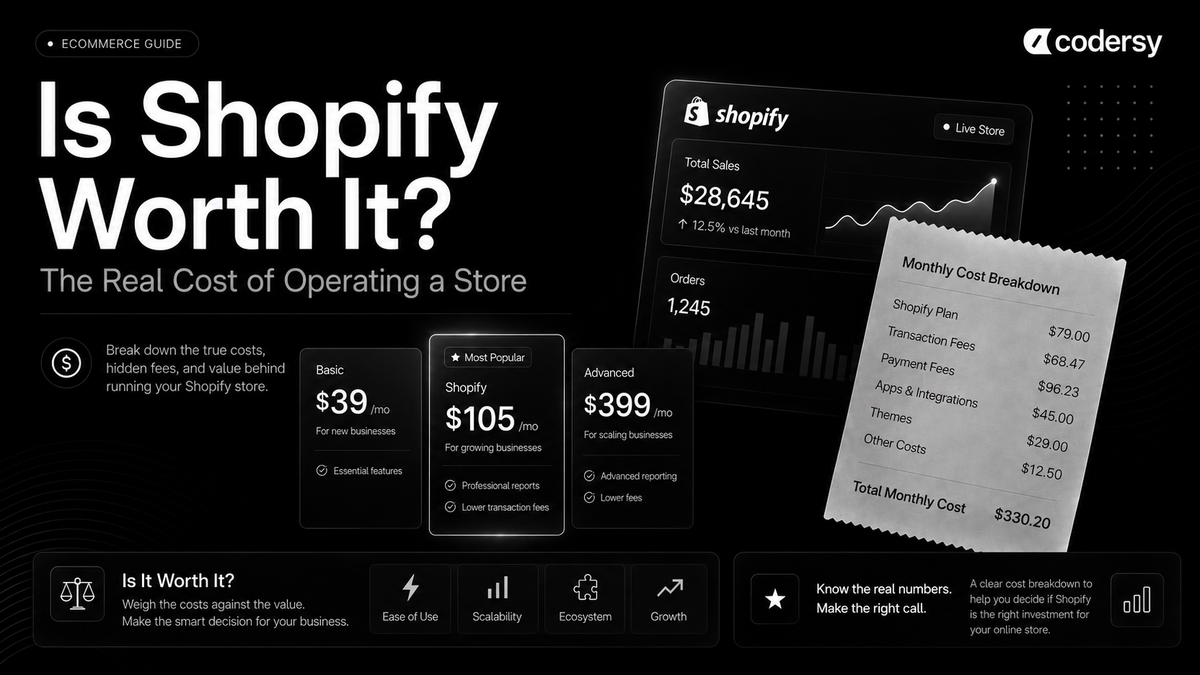
Shopify’s pricing structure includes different plans, and those plans can vary by monthly price, features, credit card rates, and third-party transaction fees, according to Shopify’s pricing and billing overview.
But the plan itself is only one part of the real bill.
A complete Shopify monthly costs vs value comparison should usually include:
- the Shopify subscription,
- payment processing costs,
- possible third-party transaction fees,
- paid apps,
- premium themes,
- custom development,
- integrations,
- reporting or marketing tools,
- email and automation software,
- agency or freelancer support,
- and the internal time spent managing the store.
This is where many new store owners miscalculate.
They look at the base plan and think they understand the cost. Then they realize the store also needs a review app, better search, email marketing, subscriptions, product options, upsells, analytics, loyalty, or integration with another system.
Not every store needs all of this.
A simple store can often start with a lean setup and add more tools later. But as the business becomes more serious, software costs can grow around the platform.
That does not automatically make Shopify a bad deal.
It means the value needs to be judged against the operating system you are building.
For example, a paid app may look like an extra cost, but it can be worth it if it replaces custom development, manual work, or a weak customer experience.
A premium theme may look unnecessary at the beginning, but it can be valuable if it gives the store better structure, stronger product presentation, and a cleaner buying experience.
Custom development may feel expensive, but it can make sense when the store needs something that cannot be solved properly with a generic template or another app.
This is the more honest way to look at Shopify pricing hidden fees as well.
Many costs are not truly hidden. They are just easy to underestimate before you know what your store actually needs.
Shopify also documents app-related charges separately, including different types of app charges that can appear on Shopify bills.
The practical takeaway is simple:
Do not ask only what Shopify costs per month. Ask what your complete store setup will cost to run properly.
That includes the plan, but also the tools, implementation, and maintenance needed to make the store useful.
For a serious ecommerce business, Shopify can be worth it when those costs create a better operating system, save time, reduce technical overhead, and support sales more effectively.
For a business with no clear offer, no traffic plan, and no need for a real ecommerce setup yet, the same costs may feel heavy because the platform is not solving the right problem.
Transaction Fees and Shopify Payments: What to Check Before You Choose a Plan
Transaction fees are one of the easiest Shopify costs to misunderstand.
Many new store owners look at the monthly plan first, then forget that payment setup can also affect the final cost of running the store.
There are two different things to separate:
- payment processing fees,
- and third-party transaction fees.
Payment processing fees are the fees charged for processing card payments and other payment methods. These exist on ecommerce platforms in general, not only on Shopify.
Third-party transaction fees are different. Shopify explains that these fees can apply when a store uses an external payment provider, and that the fee varies depending on the Shopify plan.
Shopify Payments changes the equation in many markets. Shopify states that when Shopify Payments is used as the sole payment provider, there are no third-party transaction fees for orders, aside from the credit card rate and the store’s Shopify subscription fees.
This is why a simple Shopify pricing comparison can be misleading.
Two stores can be on the same Shopify plan but have different payment costs depending on location, payment provider, card rates, currency, and whether Shopify Payments is available and suitable for that business.
This also connects directly to the “hidden fees” discussion.
Many Shopify pricing hidden fees are not hidden in the sense that Shopify hides them. They are documented, but they are easy to miss if someone only checks the monthly plan price.
The costs that often surprise new merchants include:
- paid apps,
- premium themes,
- third-party transaction fees,
- payment processing fees,
- custom development,
- integration costs,
- and tools needed for email, analytics, subscriptions, loyalty, or upsells.
For a store with real sales, these costs may be acceptable because they support revenue, operations, and customer experience.
For a store with no sales yet, they can feel much heavier because every monthly charge is coming out before the business has proved that people want to buy.
That is why Shopify monthly costs vs value depends heavily on the stage of the business.
A store doing consistent revenue may see Shopify as a useful operating cost.
A store that has not validated its product, offer, or traffic source may experience the same cost as pressure.
Shopify is not only a pricing decision. It is a timing decision.
Evaluating Shopify for Beginners and Specific Business Models
Shopify can be useful for beginners, but it is not automatically the right move for every beginner.
The platform can make it easier to launch a store, manage products, accept payments, process orders, and create a more organized ecommerce setup. But it does not remove the need for a good product, clear positioning, traffic, trust, and customer demand.
That difference matters most for small businesses, new founders, Starter plan users, and dropshipping stores.
Is Shopify Worth It for a Small Business with No Sales Yet?
Shopify can be worth it for a small business with no sales yet if the business is ready to treat the store like a serious sales channel.
A small business does not need everything figured out before launching.
But Shopify works best when the store is part of an active business plan, not a passive experiment.
For example, Shopify can make sense before the first sale if the business is preparing to run paid campaigns, build organic traffic, test product pages, collect customer data, improve conversion rates, or create a more credible brand experience.
In that situation, the platform gives the business a proper place to send traffic and measure what happens next.
But if there is no traffic plan, no product validation, no clear offer, and no budget to test the market, Shopify may feel expensive too early.
The problem is not the platform itself.
The problem is paying for store infrastructure before the business has a plan to use it.
Shopify is not a sales strategy. It is the store infrastructure that supports one.
This is especially important for small businesses.
A small business with a real product, a clear customer, and a plan to sell can benefit from Shopify because it reduces the technical work needed to operate a proper online store.
A small business that is still guessing what to sell may need validation before it needs a complete ecommerce platform.
The Truth About the Shopify Starter Plan
Shopify Starter can be worth it, but only for the right use case.
It is not really designed to replace a full online store. It is better understood as a lighter way to start selling when you do not need a complete storefront yet.
That can make sense if you already have attention somewhere else.
For example, Shopify Starter may be useful if you sell through:
- social media,
- messaging apps,
- a simple product link,
- an existing audience,
- or a small number of products that do not need a full catalog experience.
In that situation, Starter can help a beginner accept payments and test demand without building a complete ecommerce website from day one.
But it has limits.
If the goal is to build a serious brand, create landing pages, organize products into collections, invest in SEO, improve the shopping experience, publish content, or build a stronger store structure, Starter can quickly feel too limited.
That is where a full Shopify plan usually makes more sense.
Starter can be useful for validation.
It is less suitable when the business needs a real ecommerce presence.
Shopify Starter is worth it when you need a simple way to start selling. It is not worth it if you already know you need a full online store.
Is Shopify Worth It for Dropshipping?
Shopify can be worth it for dropshipping, but it does not fix the weak parts of a dropshipping business.
This is an important distinction.
Shopify can make the operational side easier. You can build product pages, connect apps, accept payments, manage orders, test offers, and launch a store faster than if you were building everything from scratch.
For that reason, many dropshipping beginners are attracted to Shopify.
But Shopify does not solve the hardest parts of dropshipping.
It does not automatically give you:
- a good product,
- healthy margins,
- reliable suppliers,
- fast shipping,
- strong branding,
- good customer support,
- profitable ads,
- or a reason why someone should buy from your store instead of another one.
A weak dropshipping store can still fail on Shopify.
A generic product, slow delivery, copied descriptions, poor trust signals, expensive ads, and low customer confidence can make the store unprofitable even if the platform itself works well.
So the answer depends on what you are using Shopify for.
If you are using Shopify as a serious testing and selling system, with a clear product angle, a real offer, better product pages, reliable fulfillment, and a plan to improve conversion, it can be worth it.
If you are using Shopify because you expect the platform to make dropshipping easy money, it probably is not worth it.
Shopify can make dropshipping easier to operate, but it does not make a weak dropshipping model profitable.
For dropshipping, the value of Shopify is not magic.
It is speed, structure, app access, checkout, and operational simplicity.
That can help a good operator move faster. It will not turn a poor offer into a strong business.
Shopify vs Cheaper Alternatives: Infrastructure vs. Lower Upfront Costs
Shopify is not the cheapest way to start selling online.
A business can start with a cheaper website builder, a marketplace, a social selling setup, a simple payment link, WooCommerce, or even no dedicated store in the very early stage.
But cheaper upfront cost does not always mean better value.
A lower-cost setup can work if you only need to test a product, collect a few orders, or sell casually to an existing audience. It can become limiting when the business needs product management, collections, discounts, checkout, payment setup, order management, analytics, apps, integrations, and a system the team can manage every day.
That is where Shopify becomes easier to justify.
You are not only paying for a website. You are paying for a more complete ecommerce environment.
For readers who want a deeper breakdown of Shopify fees, the Shopify fees explained clearly article can help clarify how Shopify charges work beyond the monthly plan.
The point is not that Shopify is always better than cheaper alternatives.
The point is that Shopify should be compared as ecommerce infrastructure, not only as a monthly software bill.
Final Verdict: When to Say Yes and When to Wait
Shopify is worth it when the business is ready to use it as a real ecommerce operating system.
Say yes to Shopify if you have a clear product, a real offer, a traffic plan, and the intention to build a proper online store instead of just testing random ideas.
It is also easier to justify when your team needs a reliable checkout, order management, product management, apps, analytics, and a cleaner admin environment.
Wait before committing to Shopify if you do not know what you want to sell, have no clear offer, have no plan to bring traffic, or only need a very simple way to test interest.
Shopify can provide the system, but it cannot replace product validation, positioning, trust, marketing, or customer demand.
For businesses that decide Shopify is the right fit, a professional Shopify store build can help turn the platform into a stronger foundation instead of just another template-based store.
The final answer is simple:
Shopify is worth it when its cost is smaller than the operational problems it helps you avoid.