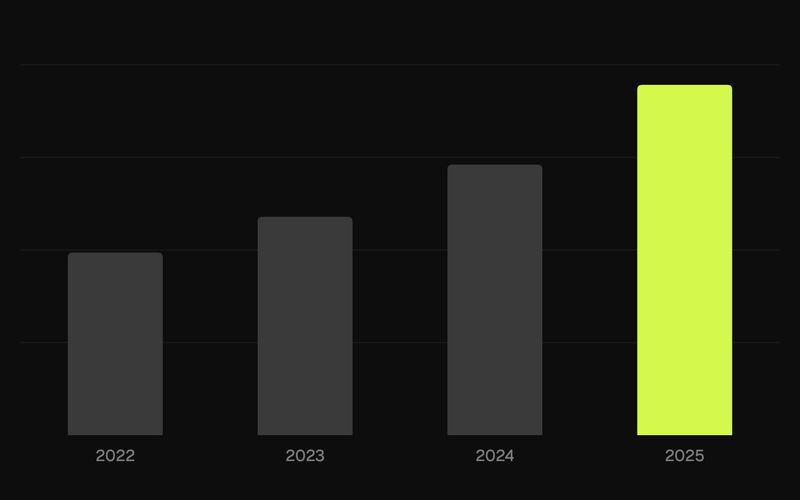
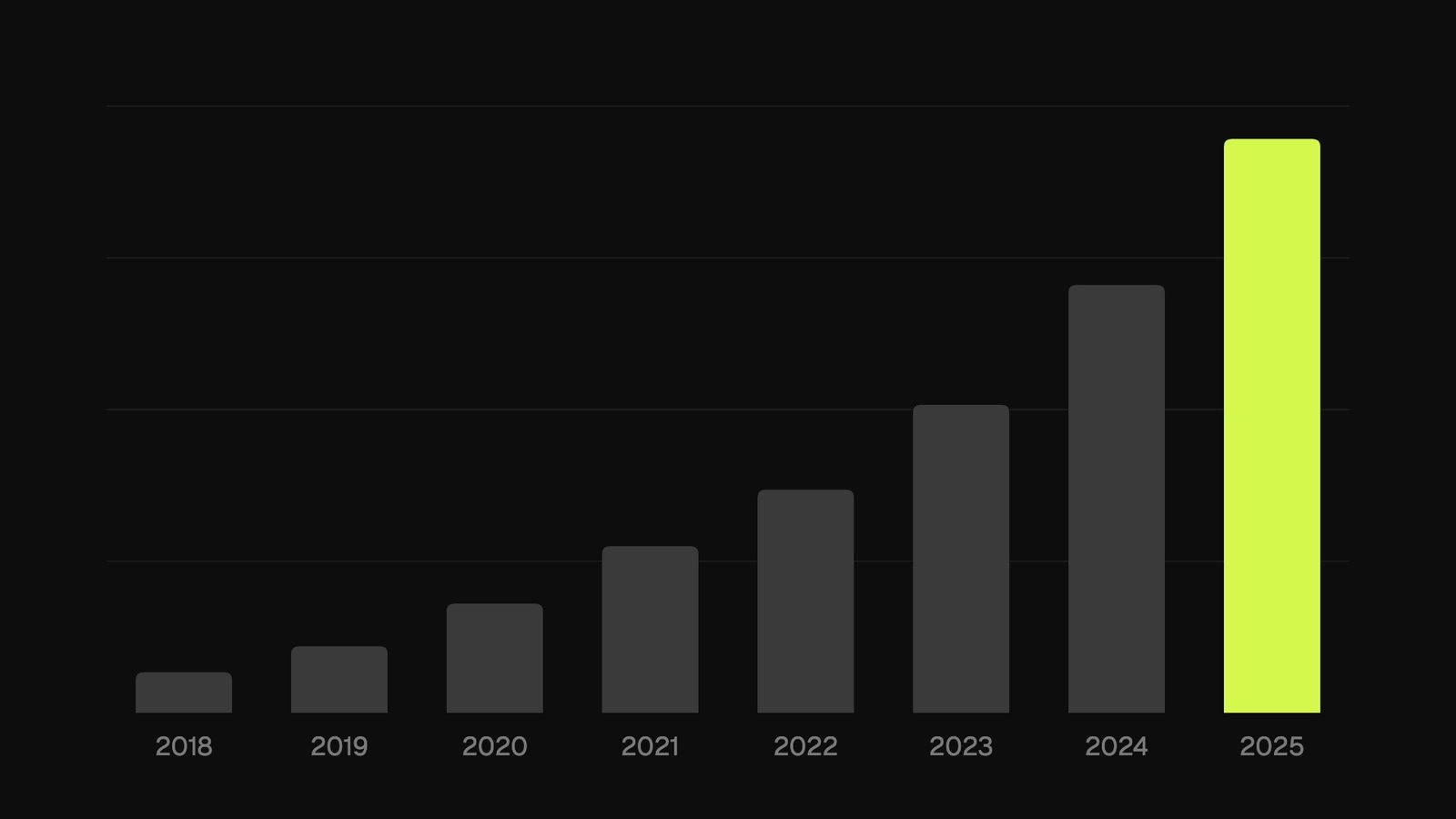
Serbia is buying online faster than most Serbian firms are selling online. The number of online card purchases grows every year, almost half of the country's express parcels come from distance selling, and only a small share of firms earn most of their turnover through their own website.
This page uses only data from the institutions that measure it: the Statistical Office of the Republic of Serbia (RZS), the National Bank of Serbia (NBS), Eurostat and RATEL, the postal and telecoms regulator. Every number links to the original table or publication and carries the date of the data. We update the page every month, whenever one of these institutions publishes new figures.
Key Takeaways
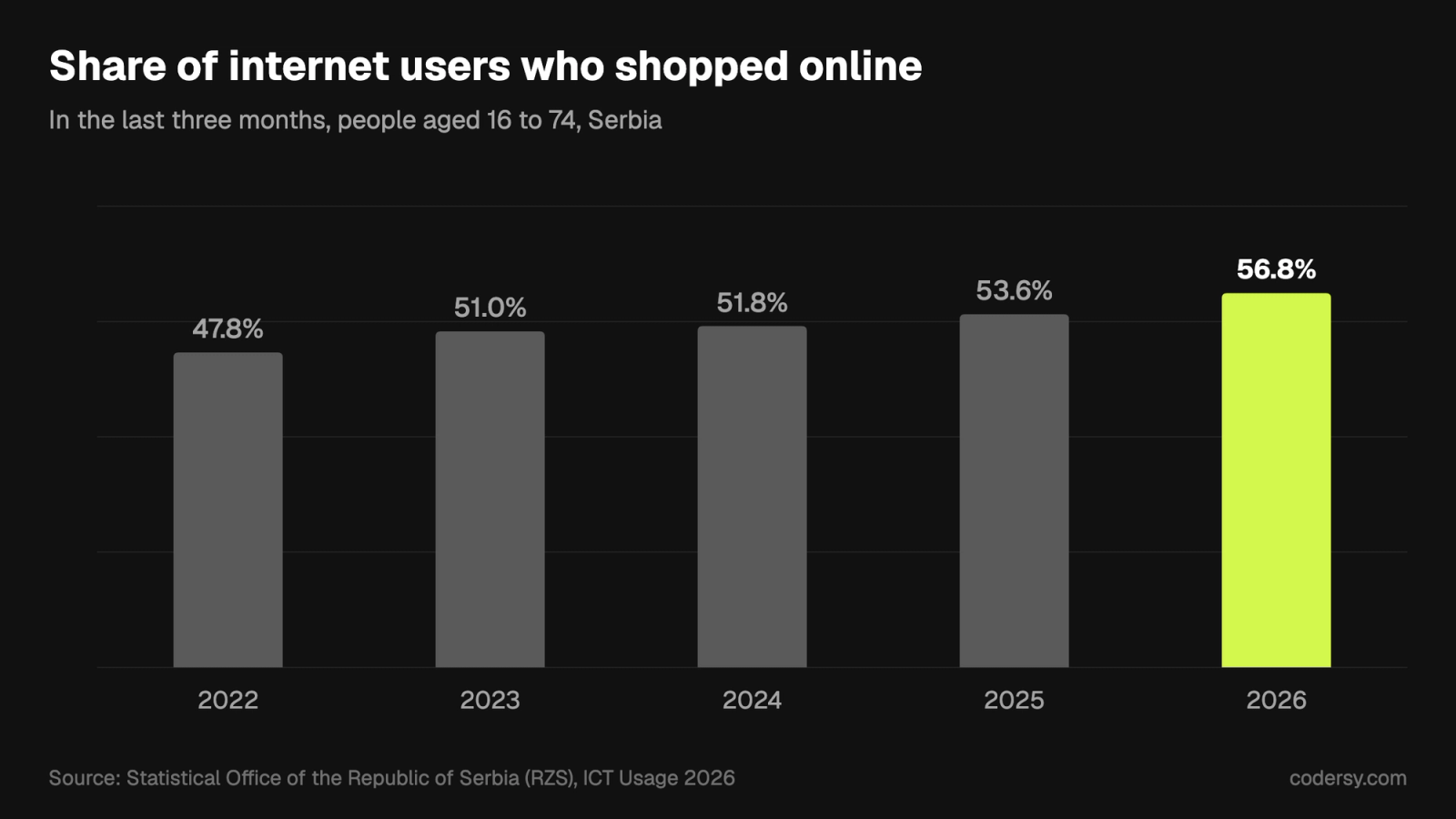
- 56.8% of internet users in Serbia bought something online in the last three months (RZS, ICT Usage 2026: individuals, October 2026).
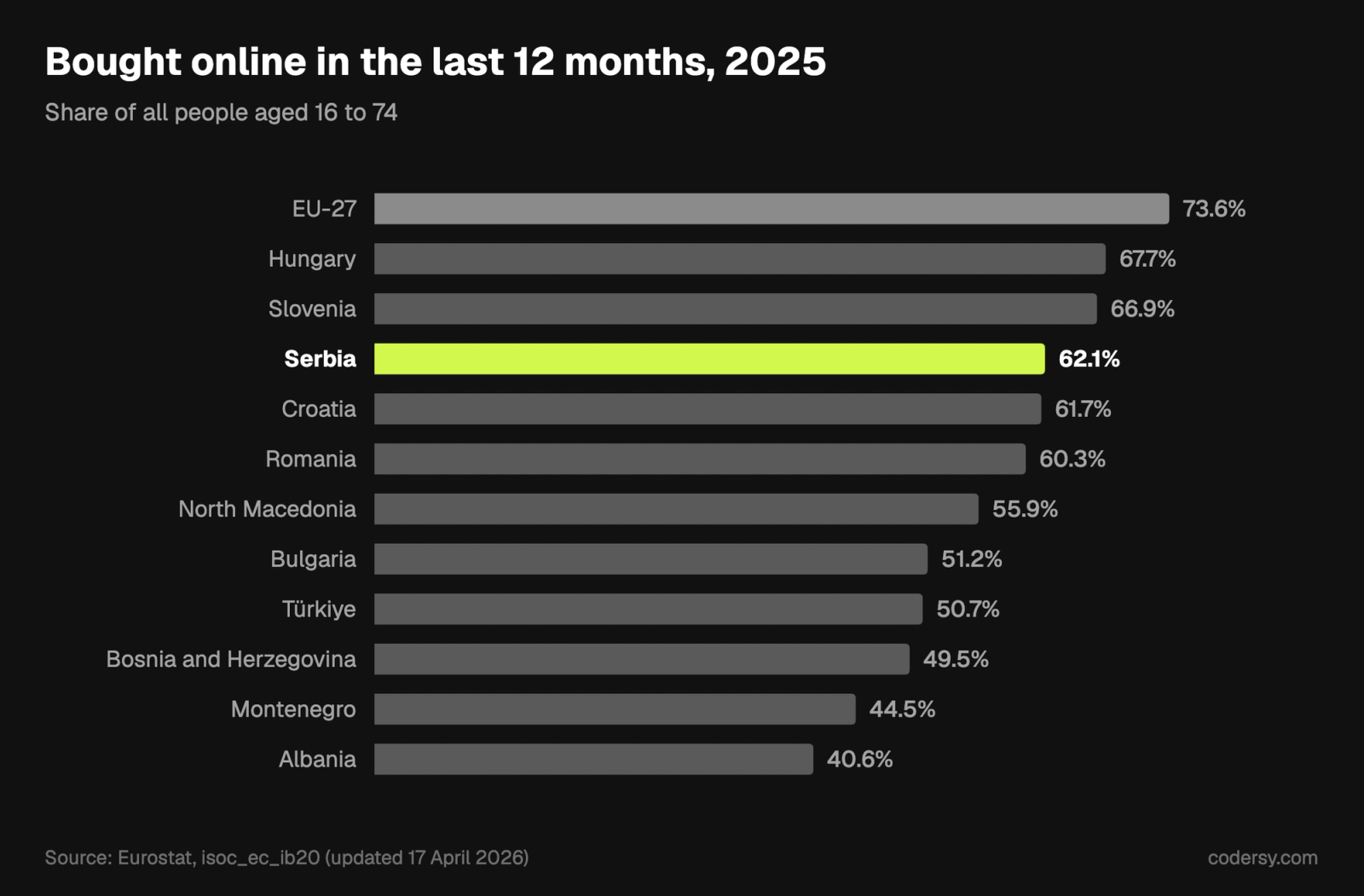
- Serbia trails the EU by 11.5 percentage points: 62.1% of people bought online, against 73.6% in the EU (Eurostat, isoc_ec_ib20, April 2026).
- Only 8.5% of people in Serbia buy online six or more times in three months, against 20.1% in the EU (Eurostat, isoc_ec_ib20, April 2026).
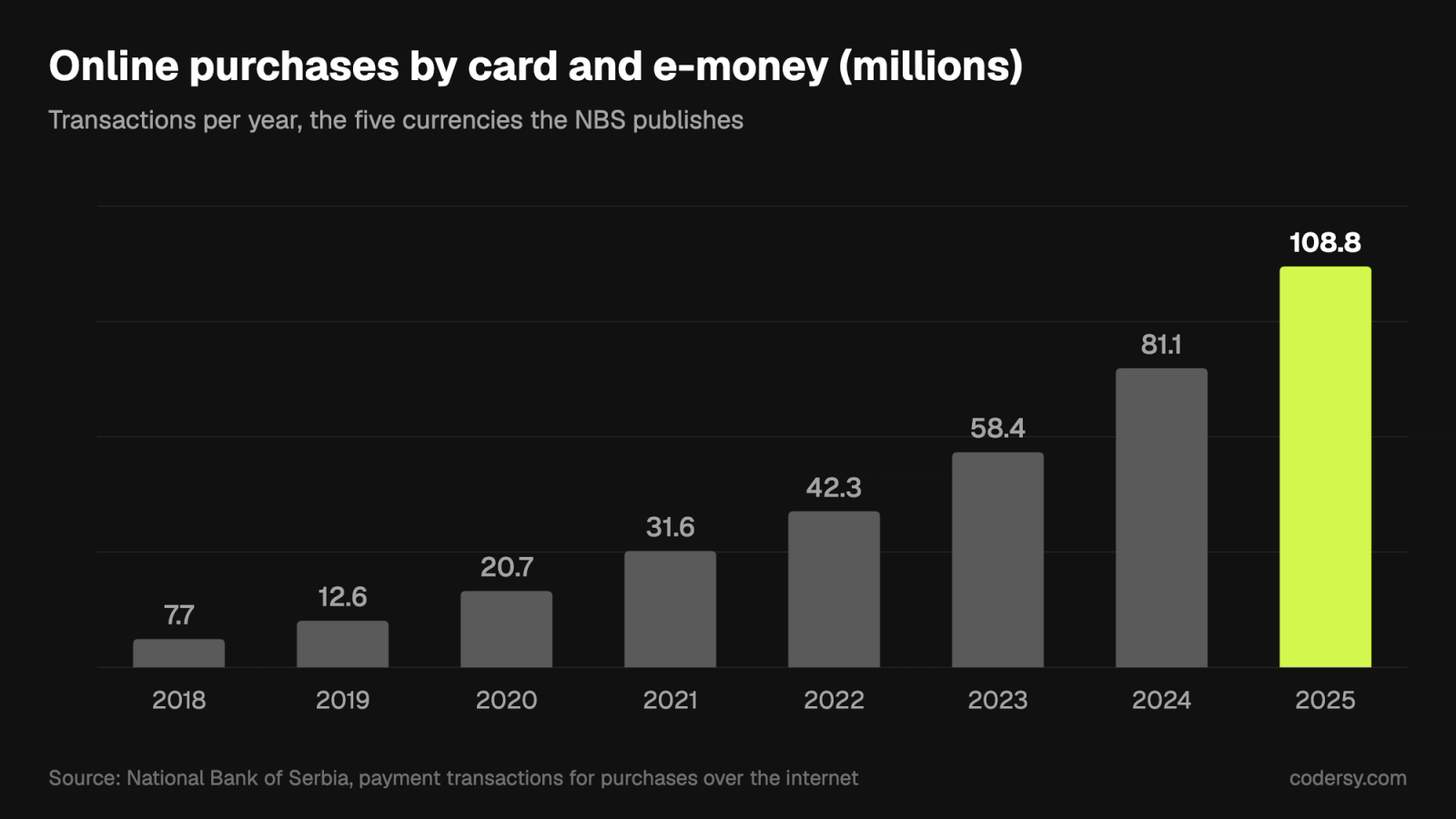
- Online purchases by card and e-money grew from 7.7 million in 2018 to 108.8 million in 2025 (NBS, Payment transactions for purchases over the internet, August 2026).
- 34.2 million online purchases were made by card and e-money in Q2 2026, 28.5% more than a year earlier (NBS, Payment services review for Q2 2026, August 2026).
- Online purchases priced in dinars were worth 237.4 billion dinars in 2025 (NBS, Payment transactions for purchases over the internet, February 2026).
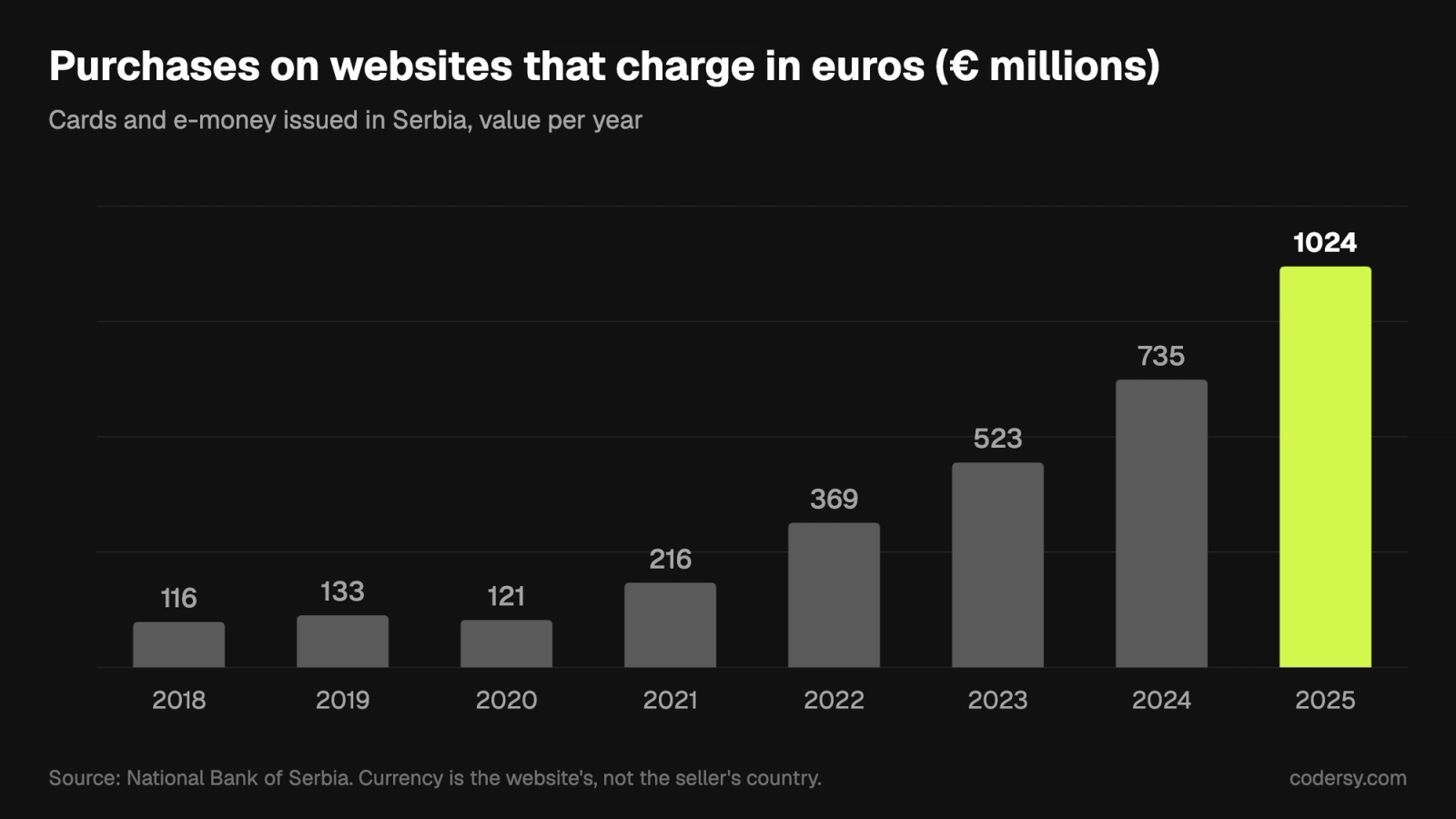
- Purchases on websites that charge in euros reached €1.02 billion in 2025, against €116 million in 2018 (NBS, Payment transactions for purchases over the internet, February 2026).
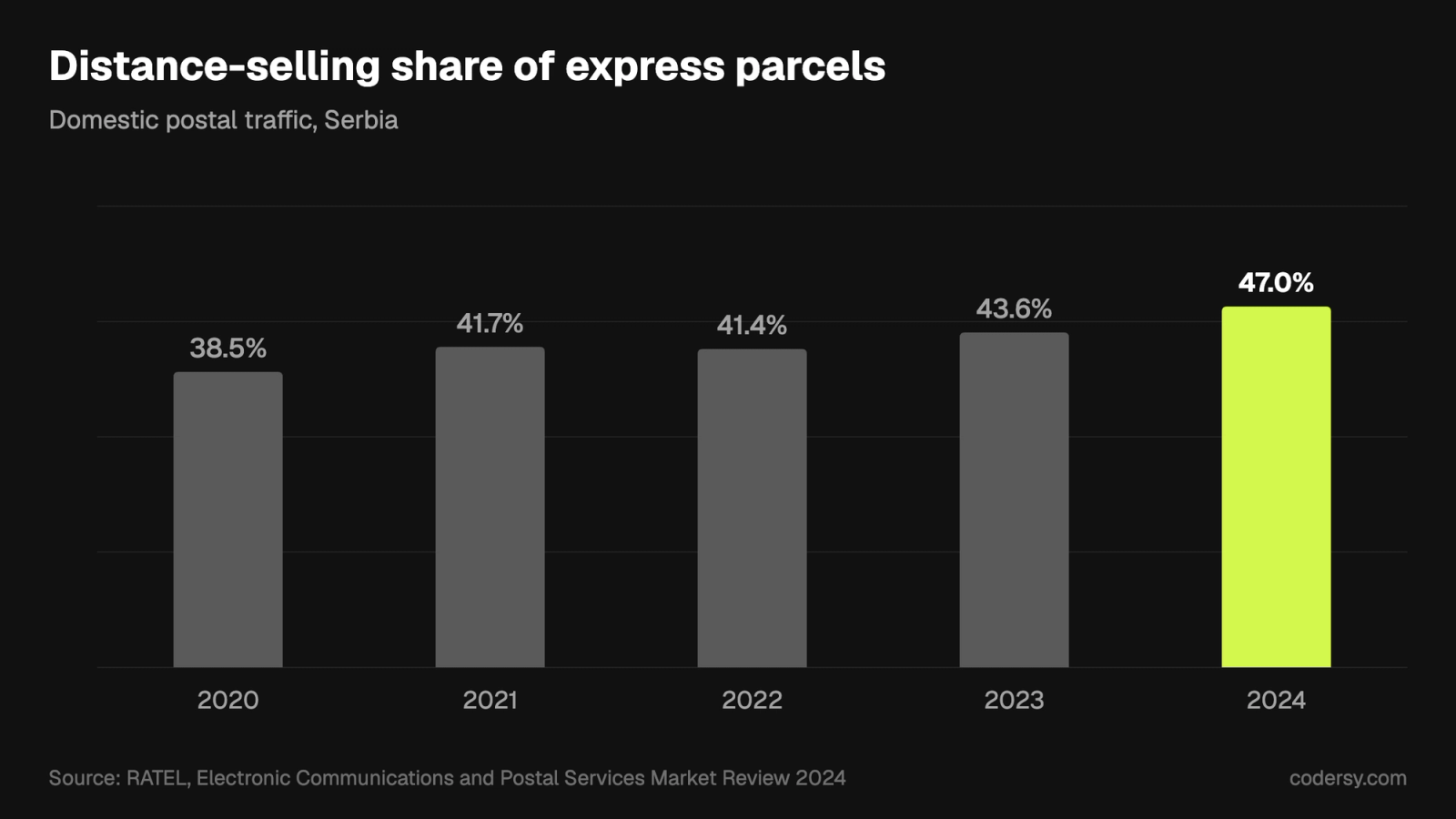
- 47% of express parcels in Serbia come from distance selling (RATEL, Electronic Communications and Postal Services Market Review 2024, September 2025).
- Cash on delivery does not exist in NBS statistics: online purchases are counted only for cards, mobile phones, e-money and e-banking (NBS, Payment transactions for purchases over the internet, August 2026).
- 28.8% of firms in Serbia sold online in 2025 (RZS, ICT Usage 2026: enterprises, October 2026).
- Only 6.7% of Serbian firms sell online abroad, against 8.9% in the EU (Eurostat, isoc_ec_eseln2, June 2026).
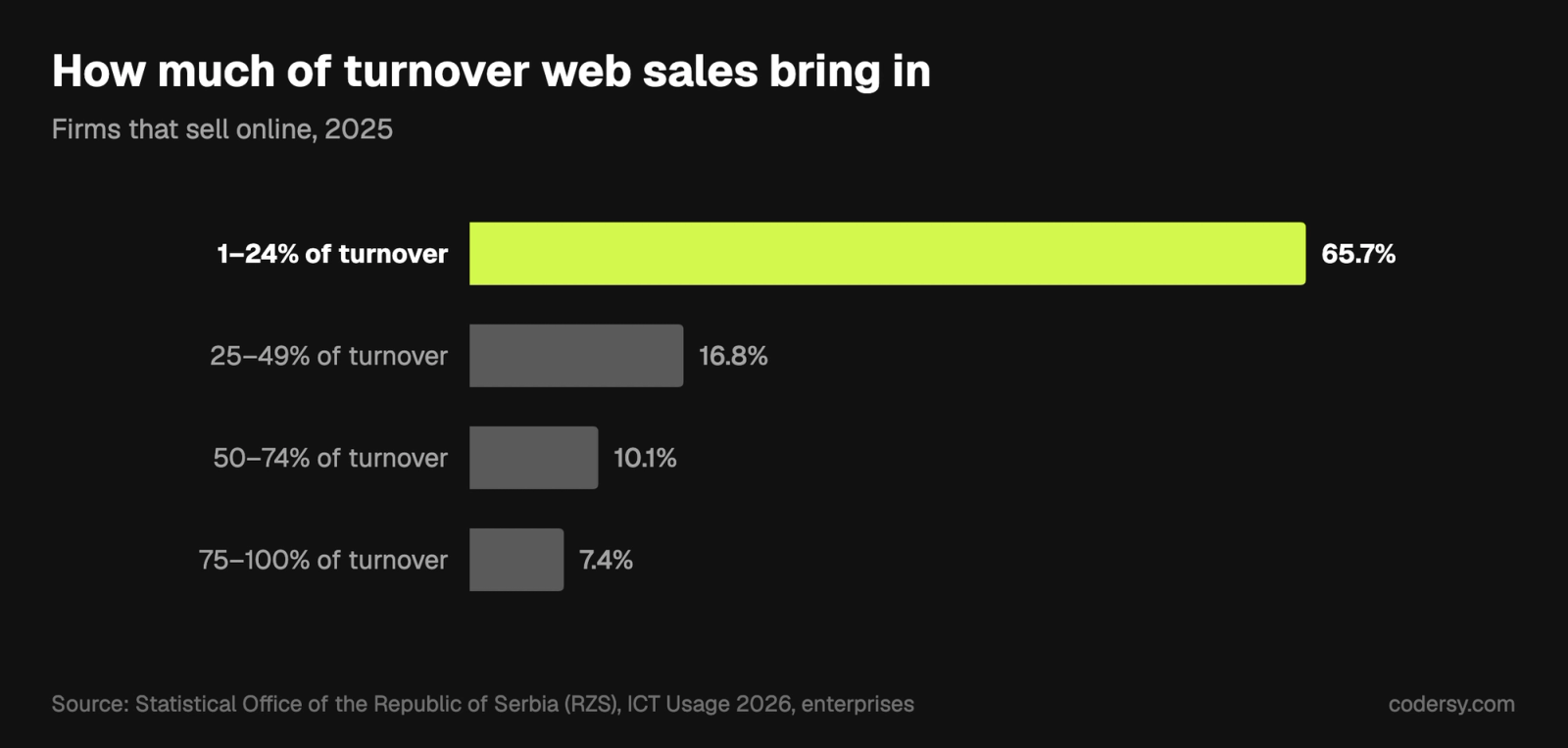
- For 65.7% of firms that sell online, the internet brings in less than a quarter of turnover (RZS, ICT Usage in the Republic of Serbia 2026, October 2026).
- 31.8% of internet users used generative AI in the last three months (RZS, ICT Usage in the Republic of Serbia 2026, October 2026).
How many people in Serbia shop online?
Half of Serbia's online population shops online every quarter. The other half is a market still up for grabs, and it shrinks every year.
What share of internet users shops online?
More every year. In 2022, 47.8% of internet users had bought online in the last three months, and the share has risen every year since (RZS, ICT Usage in the Republic of Serbia 2026, October 2026). 20.2% of internet users have never bought anything online (RZS, ICT Usage in the Republic of Serbia 2026, October 2026). 91.8% of people aged 16 to 74 used the internet in the last three months, so the pool of potential buyers is almost the whole adult population (RZS, ICT Usage in the Republic of Serbia 2026, October 2026). 91.2% of households have an internet connection (RZS, ICT Usage in the Republic of Serbia 2026, October 2026).
Who shops online: age and education
The age gap is bigger than any other. 77.2% of internet users aged 16 to 24 bought online in the last three months, against 22.0% of those aged 65 to 74 (RZS, ICT Usage in the Republic of Serbia 2026, October 2026). Women shop online slightly more often than men: 57.7% against 55.9% (RZS, ICT Usage in the Republic of Serbia 2026, October 2026). 72.8% of people with higher education shop online, against 37.5% of those with less than secondary education (RZS, ICT Usage in the Republic of Serbia 2026, October 2026). A store aimed at an older audience sells to people who buy online less often and trust more slowly.
How often does Serbia shop online?
Rarely, compared with the EU. 25.6% of people in Serbia made one or two purchases in three months, more than in the EU (21.3%), while 16.4% made three to five, against 20.9% in the EU (Eurostat, isoc_ec_ib20, April 2026). 3.1% of people in Serbia made more than ten purchases in three months, against 9.5% in the EU (Eurostat, isoc_ec_ib20, April 2026). The Serbian online shopper is more often an occasional buyer, so every purchase has to be easy the first time.
How does Serbia compare with the EU and the region?
Serbia sits in the middle of the region and is catching up fast. The gap to the EU is in how often people buy and what they buy, not only in how many buy.
Where does Serbia stand in the region?
Ahead of most neighbours. In 2025, 67.7% of people in Hungary bought online, 66.9% in Slovenia, 61.7% in Croatia, 60.3% in Romania, 55.9% in North Macedonia and 51.2% in Bulgaria (Eurostat, isoc_ec_ib20, April 2026). Bosnia and Herzegovina is at 49.5%, Montenegro at 44.5% and Albania at 40.6% (Eurostat, isoc_ec_ib20, April 2026).
How fast is Serbia catching up?
Faster than almost anyone. From 2020 to 2025 the share of people in Serbia who shop online rose from 38.4% by 23.7 percentage points; in the region only Albania grew faster (Eurostat, isoc_ec_ib20, April 2026).
What do people in Serbia buy online compared with the EU?
Clothes, but hardly any cosmetics or electronics. In the last three months, 33.2% of people in Serbia bought clothes, shoes or accessories online, against 42.3% in the EU (Eurostat, isoc_ec_ibgs, April 2026). 2.1% bought cosmetics online, against 18.8% in the EU, and 2.8% bought electronics and household appliances, against 10.8% (Eurostat, isoc_ec_ibgs, April 2026). Sports goods are close to the EU level: 13.5% against 15.4% (Eurostat, isoc_ec_ibgs, April 2026). 47.5% of people in Serbia bought any physical goods online, against 59.0% in the EU (Eurostat, isoc_ec_ibgs, April 2026). 2.9% ordered restaurant food delivery online, against 19.8% in the EU (Eurostat, isoc_ec_ibgs, April 2026). The category data is for 2024, the latest year Eurostat has for Serbia.
How much money goes through online payments?
Online card payments grow by double digits every year. But the NBS sees only part of the purchases, because cash on delivery never passes through a bank.
How many purchases are paid by card online?
More every year. There were 20.7 million transactions in 2020, 42.3 million in 2022 and 81.1 million in 2024, in the five currencies the NBS publishes (NBS, Payment transactions for purchases over the internet, February 2026). In the first half of 2026 there were 48.2 million purchases in dinars, 37.2% more than in the first half of 2025, by our calculation from the NBS table (NBS, Payment transactions for purchases over the internet, August 2026).
How much are online purchases in dinars worth?
Value grows faster than the number of purchases. In the first half of 2026, purchases in dinars were worth 148.9 billion dinars, 41.8% more than a year earlier, by our calculation from the NBS table (NBS, Payment transactions for purchases over the internet, August 2026). The dinar share of transactions rose from 37.1% in 2018 to 73.0% in the first half of 2026 (NBS, Payment transactions for purchases over the internet, August 2026). The number of online payments in dinars rose 30.8% in the second quarter (NBS, Payment services review for Q2 2026, August 2026).
How do online payments compare with payments in shops?
Online is still a small part, but it grows faster. Cards from domestic banks were used for 220.9 million payments in shops across Serbia in Q2 2026, 19.1% more than a year earlier (NBS, Payment services review for Q2 2026, August 2026). Mobile banking handled 42.6 million payments, 26.8% more (NBS, Payment services review for Q2 2026, August 2026). 44.7% of internet users use internet banking (RZS, ICT Usage in the Republic of Serbia 2026, October 2026).
How many stores accept cards and instant payments?
More and more. The number of virtual points of sale, that is, online card acceptance, rose 21.4% in a year, and 13.66 million payment cards have been issued (NBS, Payment services review for Q2 2026, August 2026). The IPS system processed 34.5 million instant payments in Q2, 30.7% more than a year earlier, and IPS Skeniraj and IPS Pokaži also work at online points of sale (NBS, Payment services review for Q2 2026, August 2026).
How much does Serbia buy from foreign online stores?
More than one in four online card purchases is not in dinars. Foreign stores take a growing slice, and Serbian firms rarely sell abroad.
How much do Serbs buy in euros and dollars?
A lot. In 2025 there were 23.8 million purchases on websites that charge in euros and 6.1 million purchases in dollars, worth $244 million (NBS, Payment transactions for purchases over the internet, February 2026). Of all online transactions in the five currencies the NBS publishes, 27.8% were not in dinars (NBS, Payment transactions for purchases over the internet, February 2026). One caveat: the NBS records the currency the website sells in, not the seller's country, so a Serbian site that charges in euros is counted here too.
What drives the growth in parcels from abroad?
Chinese platforms. RATEL says the growth in express parcels in 2024 came mainly from goods imported from China through the Temu platform and then delivered as express parcels inside Serbia (RATEL, Electronic Communications and Postal Services Market Review 2024, September 2025).
How many Serbian firms sell online abroad?
Few, and fewer than EU firms. 5.3% of Serbian firms sell online to customers in the EU, while 8.6% of EU firms sell to other EU countries; 3.8% of Serbian firms sell to customers outside the EU, against 5.2% of EU firms (Eurostat, isoc_ec_eseln2, June 2026). One reason is payments: Shopify Payments is not available to Serbian companies (Shopify Help Center, Supported countries and regions for Shopify Payments, November 2026). Selling into the EU therefore usually runs through a merchant of record or a separate payment gateway. If you plan to sell beyond Serbia, see how we build Shopify for Serbian companies.
Cash on delivery: what the official data does not show
Every Serbian store we have built offers cash on delivery, but no institution measures its share. So we track parcels instead of payments.
Why is cash on delivery missing from NBS statistics?
Because it never passes through a payment service provider. The NBS table of online purchases is built from data supplied by banks and other payment service providers and covers payments by card, mobile phone, e-money and e-banking (NBS, Payment transactions for purchases over the internet, August 2026). Cash handed to a courier is not in it, so the real number of online purchases is higher than the NBS figure.
How many parcels come from online selling?
Almost one in two. In 2024, 52.9 million express parcels were sent inside Serbia, and 24.8 million of them came from distance selling (RATEL, Electronic Communications and Postal Services Market Review 2024, September 2025). Distance-selling parcels grew 21.3%, while all express parcels grew 12.5% (RATEL, Electronic Communications and Postal Services Market Review 2024, September 2025). 95% of these parcels contain goods, and the largest group is parcels up to 500 grams, at 39% (RATEL, Electronic Communications and Postal Services Market Review 2024, September 2025). RATEL notes that these goods are paid for electronically or on delivery, but does not measure the share of each. Distance-selling parcels bring in just over 42% of domestic express parcel revenue (RATEL, Electronic Communications and Postal Services Market Review 2024, September 2025).
What does the law require of a store that takes cash on delivery?
A fiscal receipt and a refund on time. A customer can withdraw from a distance purchase within 14 days, and the seller must refund the money by the same means of payment unless the customer expressly agrees to another (Paragraf, Consumer Protection Law, November 2026). Since the 2026 amendment, a receipt with a QR code not generated through the Tax Administration's system brings a one-year ban on trading (Paragraf, Law amending the Law on Fiscalisation, August 2026). More in the glossary: cash on delivery and fiscalization.
How many Serbian firms sell online?
Serbian firms sell online more often than EU firms, but earn little from it. The biggest room for growth is in how much turnover goes through the website.
Which firms sell online?
Large ones first. 42.3% of large, 29.8% of medium and 27.7% of small enterprises sold over the internet (RZS, ICT Usage in the Republic of Serbia 2026, October 2026). By Eurostat's method, 27.8% of Serbian firms with 10 or more employees have web sales, against 20.7% in the EU (Eurostat, isoc_ec_eseln2, June 2026).
How much turnover do online sales bring in?
Little, for most. 16.8% of firms that sell online make between a quarter and a half of turnover online, 10.1% between a half and three quarters, and only 7.4% make 75% or more (RZS, ICT Usage in the Republic of Serbia 2026, October 2026).
Own store or marketplace?
Own store, in most cases. For 74.8% of firms that sell online, 75–100% of web sales go through their own website or app (RZS, ICT Usage in the Republic of Serbia 2026, October 2026). 25.0% of Serbian firms sell through their own website, against 17.7% in the EU, and 10.7% through marketplaces, against 9.3% (Eurostat, isoc_ec_eseln2, June 2026). Only 2.7% of Serbian firms sell through marketplaces alone, with no website of their own, against 3.0% in the EU (Eurostat, isoc_ec_eseln2, June 2026).
Who do firms sell to online?
Consumers, more than in the EU. 26.0% of Serbian firms sell online to consumers (B2C), against 17.2% in the EU, and 17.4% sell to other firms or the state (B2B and B2G), against 13.8% (Eurostat, isoc_ec_eseln2, June 2026).
How digitally ready are firms?
Almost every firm has a website, but the systems behind it are rare. 85.8% of firms have a website, 27.2% use ERP software and 22.7% use CRM (RZS, ICT Usage in the Republic of Serbia 2026, October 2026). Without an ERP integration, online sales stay manual work, which is a common reason they remain a small part of turnover. If your company is just starting to sell online, see how we build Shopify stores in Serbia.
AI and the future of online shopping in Serbia
Young people in Serbia already use AI widely, and firms are lagging. Buying through AI assistants is not yet open to Serbian stores.
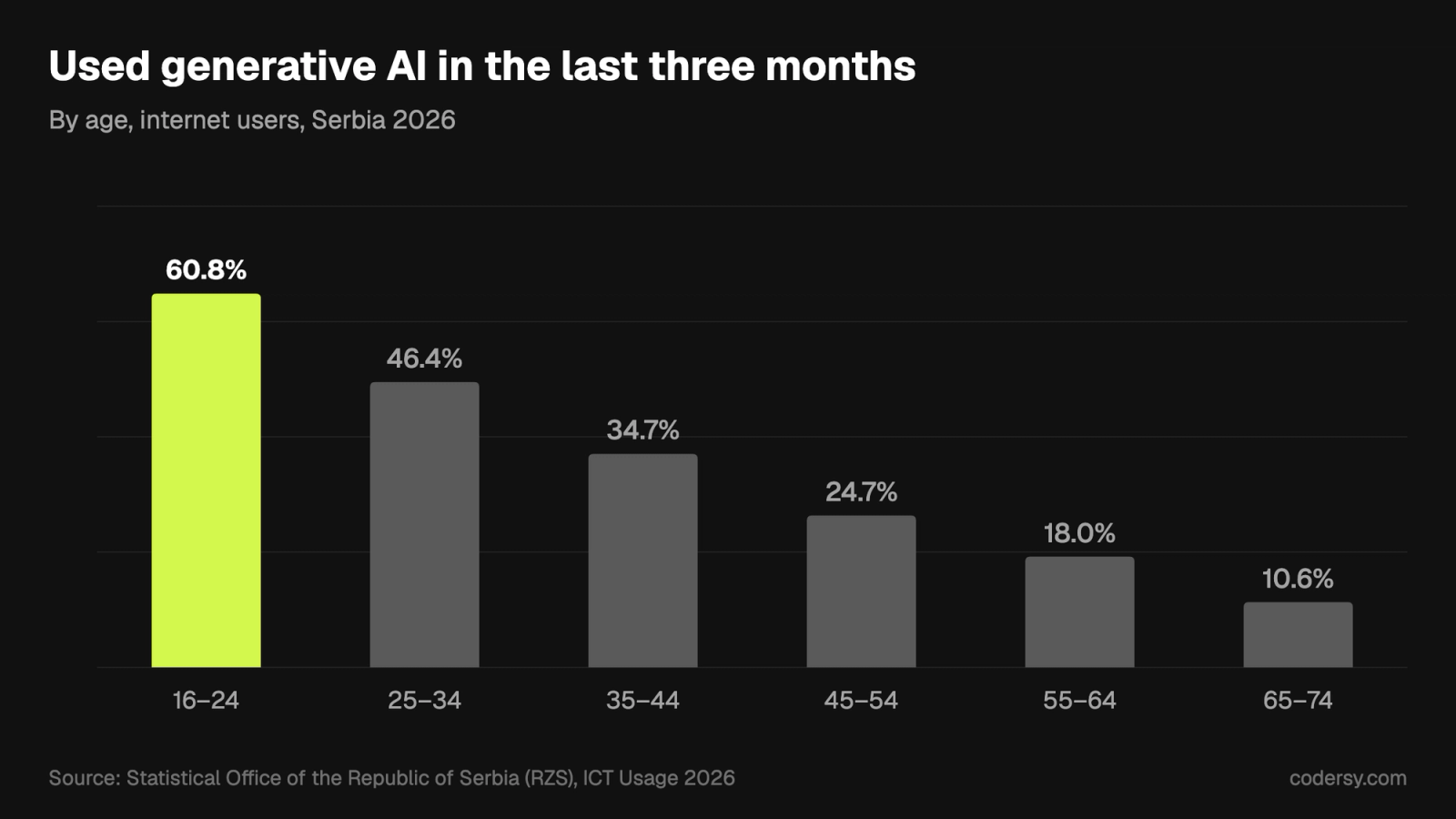
Who uses generative AI?
The young, above all. 60.8% of internet users aged 16 to 24 used tools such as ChatGPT, Copilot or Gemini, against 10.6% of those aged 65 to 74 (RZS, ICT Usage in the Republic of Serbia 2026, October 2026). Of those who use AI, 75.1% use it for private purposes and 41.3% for work (RZS, ICT Usage in the Republic of Serbia 2026, October 2026).
How many firms use AI?
One in six. 17.2% of enterprises use artificial intelligence: 20.4% in Belgrade, 15.8% in Vojvodina, 16.7% in Southern and Eastern Serbia and 12.5% in Šumadija and Western Serbia (RZS, ICT Usage in the Republic of Serbia 2026, October 2026).
Can a Serbian store sell through ChatGPT?
Only if it sells to customers in the US. Shopify's ChatGPT channel requires the store to sell to US customers, while the business itself can be based anywhere (Shopify Help Center, ChatGPT agentic storefronts, November 2026). For now the best preparation is a clean product catalog; more in the glossary: agentic commerce.
Methodology and Sources
We use only data from the institutions that measure it themselves, and we link the original tables and publications, not news stories about them. Figures from different sources measure different things: RZS measures internet users aged 16 to 74 in the last three months, Eurostat all people aged 16 to 74 in the last 12 months, the NBS the number and value of transactions, and RATEL the number of parcels. So we do not add them up or compare them directly. Where a growth rate is our own calculation from an official table, the text says so. We update the page every month; RZS annual data comes out in October, Eurostat in April and June, and the NBS every quarter.
Sources
- Statistical Office of the Republic of Serbia, ICT Usage in the Republic of Serbia 2026 (publication, in Serbian)
- Statistical Office of the Republic of Serbia, ICT usage: individuals, 2026
- Statistical Office of the Republic of Serbia, ICT usage: enterprises, 2026
- National Bank of Serbia, Payment transactions for purchases of goods and services over the internet (xlsx)
- National Bank of Serbia, Review of payment services data for Q2 2026 (in Serbian)
- Eurostat, Internet purchases by individuals (isoc_ec_ib20)
- Eurostat, Internet purchases: goods or services (isoc_ec_ibgs)
- Eurostat, E-commerce sales of enterprises (isoc_ec_eseln2)
- RATEL, Electronic Communications and Postal Services Market Review in the Republic of Serbia 2024 (in Serbian)
- Paragraf, Consumer Protection Law (in Serbian)
- Paragraf, Law amending the Law on Fiscalisation, 80/2026 (in Serbian)
- Shopify Help Center, Supported countries and regions for Shopify Payments
- Shopify Help Center, ChatGPT agentic storefronts
Glossary
- RZS: the Statistical Office of the Republic of Serbia, the official producer of statistics.
- NBS: the National Bank of Serbia, which also publishes payment system statistics.
- RATEL: the Regulatory Agency for Electronic Communications and Postal Services.
- IPS: the NBS instant payment system, including QR code payments.
- Distance selling: selling without the buyer and seller meeting, over the internet, phone or catalog.
- B2C, B2B, B2G: selling to consumers, to other firms and to the state.
- ERP and CRM: business management software and customer relationship software.
- Merchant of record: the company that legally sells the goods to the buyer and handles payment and tax.
- Generative AI: tools that produce text, images or code, such as ChatGPT and Gemini.
Scaling on Shopify Plus?
Migration, B2B, architecture, performance — we run the engagements other agencies hand back.
The checklist we run before touching a client's code
Get it by email, plus a few short notes over the next two weeks: what we see most often on Shopify stores and what actually fixes it.
Want more of our posts in your Google results? Add Codersy as a preferred source.
Add Codersy on Google(opens in a new tab)