

Shopify works in Serbia: a Serbian company or sole trader can open a Shopify store, run it from an admin in Serbian and sell to customers in Serbia with prices in dinars. Plans start at $39 a month ($29 billed yearly). Three things work differently than in the EU: Shopify Payments and Stripe aren't available, so cards go through a separate card processor; Shopify charges 0.2% to 2% on those payments; and fiscalisation and couriers are connected through separate integrations.
This article covers what you need to know before opening a Shopify store in Serbia: what it costs, how you take payments, how fiscalisation works, and what we have learned building stores for Serbian brands. We checked prices and rules on Shopify's and the Serbian Tax Administration's official pages in November 2026.
Does Shopify work in Serbia?
Yes. Anyone in Serbia can open a Shopify store, and Store Leads counted 2,655 live Shopify stores in Serbia in November 2026. The admin is available in Serbian, and customers see the store in whichever language you choose.
Stores we built, Hop Hop Shop, Klompe Shop and M&L Butik, sell to customers in Serbia on Shopify with dinar prices and cash on delivery. What Shopify doesn't offer for Serbia out of the box is solved with integrations, covered below.
How much does Shopify cost in Serbia?
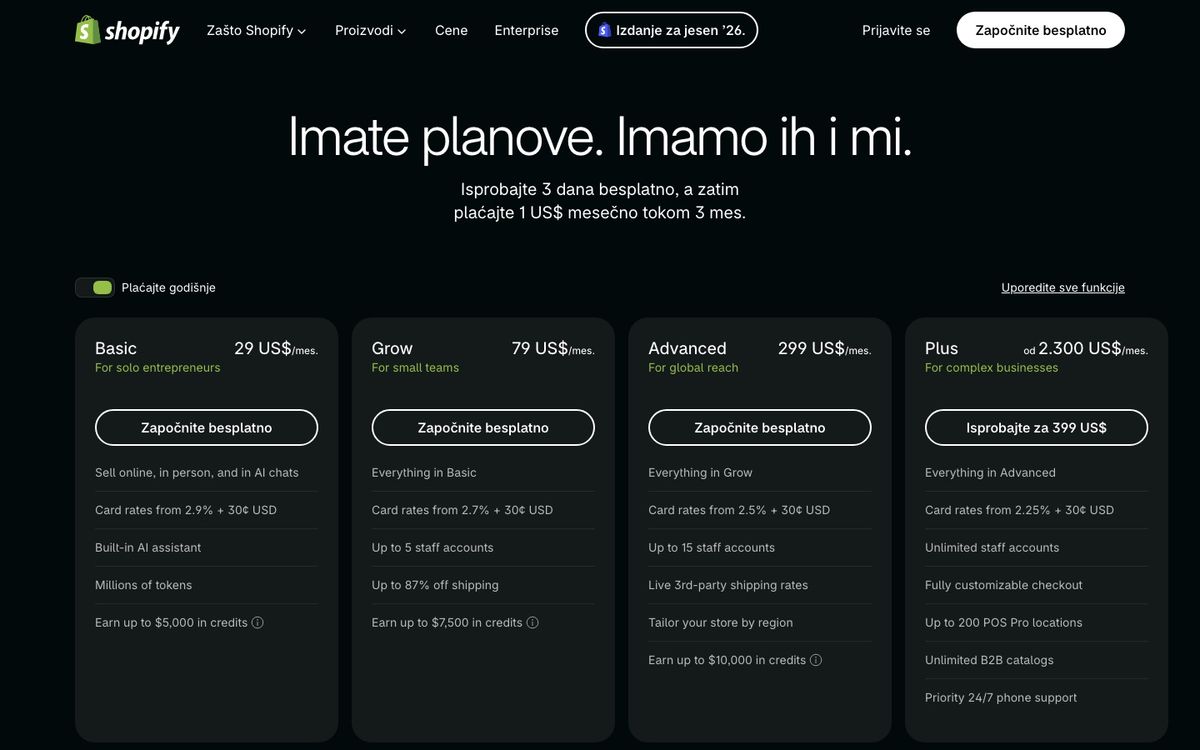
Shopify bills Serbian merchants in US dollars. These are the prices on Shopify's Serbian pricing page in November 2026:
| Plan | Billed monthly | Billed yearly (per month) | Fee on payments through other providers |
|---|---|---|---|
| Basic | $39 | $29 | 2% |
| Grow | $105 | $79 | 1% |
| Advanced | $399 | $299 | 0.6% |
| Plus | from $2,300 | — | 0.2% |
Basic, Grow and Advanced come with a 3-day free trial, then $1 a month for the first 3 months. There is no setup fee. On top come apps (most are billed monthly, in dollars), a paid theme if you choose one, the domain and payment costs. Budget roughly 2,000 to 3,000 dinars a year for a .rs domain: RNIDS charges registrars 1,700 dinars excluding VAT, and registrars set their own retail price.
The full first-year budget, with the build and monthly costs, is in our article on how much an online store costs in Serbia. To see the fees for your own sales, use our Shopify fee calculator.
How does a Shopify store in Serbia take payments?
Shopify Payments isn't available in Serbia, and Stripe doesn't accept Serbian companies. Stores combine:
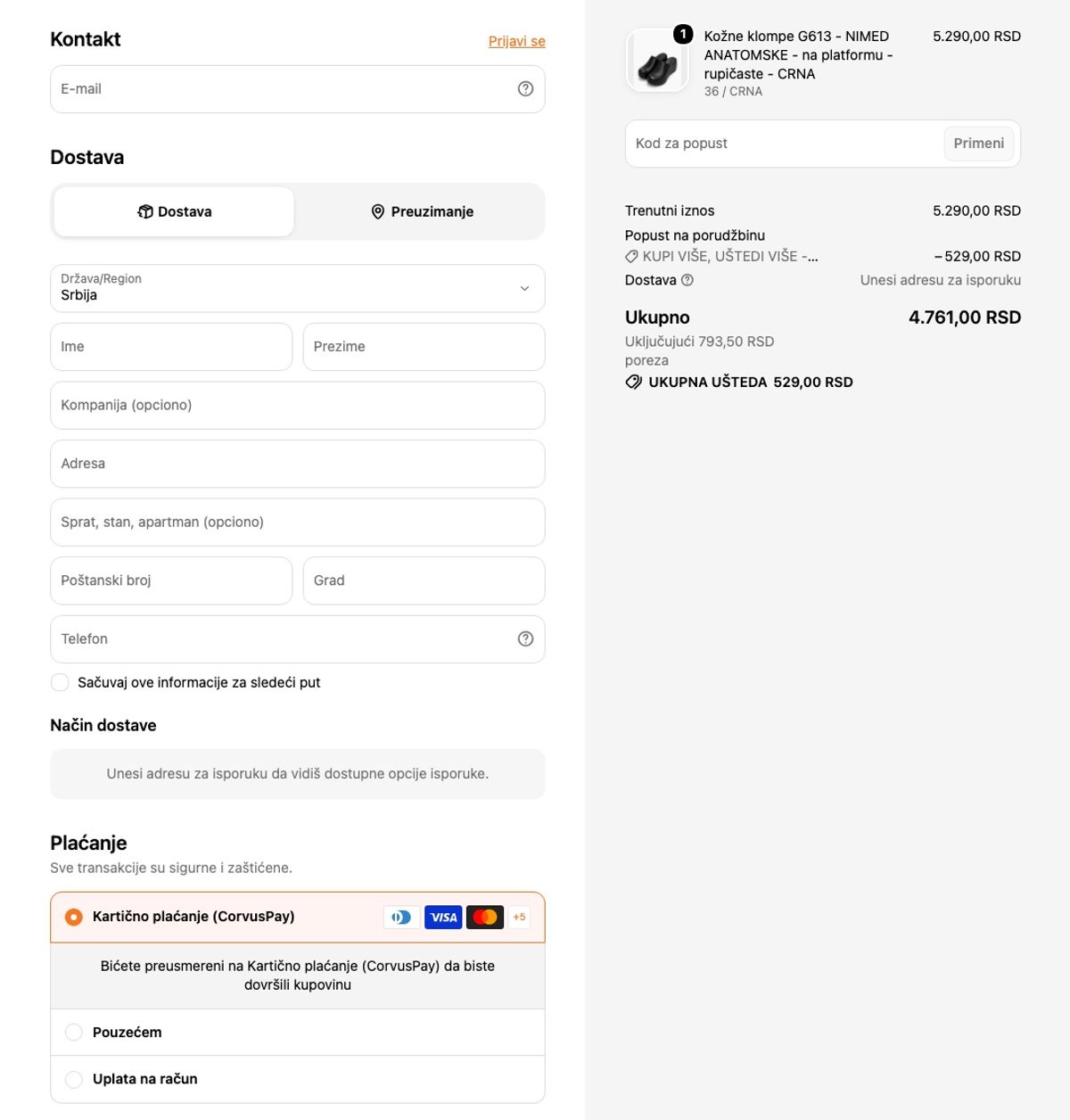
- Cards through a processor that works with Serbian companies. On Hop Hop Shop and Klompe Shop that is CorvusPay: the customer picks card payment at checkout and is sent to CorvusPay's page to pay. You need a registered company or sole trader and a contract with the processor.
- Bank transfer. Both stores also offer payment to the company's bank account, set up as another manual payment method.
- Cash on delivery. A manual payment method in Shopify, with no Shopify fee.
- PayPal for customers abroad. It doesn't support the dinar, so it needs prices in euros or dollars.
Because Shopify Payments isn't available, Shopify charges the fee in the table above on every payment through another provider, on top of the processor's own fee. Cash on delivery is exempt. Which processors work with Shopify, what they cost and what the law requires are covered in how Serbian online stores take payments.
How does fiscalisation work on Shopify?
Under Serbia's Law on Fiscalisation, sales through a web shop require a fiscal receipt. According to the Tax Administration's answers, a seller that sells only online issues the receipt electronically and can use the free virtual fiscal processor (V-PFR), with a security element obtained through the ePorezi portal. You only pay for the ESIR, the software that issues the receipts. Example cloud ESIR prices in November 2026:
- BokaPOS: 1,600 dinars a month including 600 fiscal documents, then 1 dinar per document;
- IntelliPOS: 1,199 dinars a month plus VAT, or 1,500 dinars plus VAT with advance invoices.
Shopify has no built-in Serbian fiscalisation, so the store is connected to a fiscalisation system through an integration. On Klompe Shop and Hop Hop Shop every order is fiscalised automatically through Sparkom. Interpretations differ on how to fiscalise orders paid cash on delivery, so confirm that with your accountant before launch.
Shipping and couriers
Shopify doesn't come with ready integrations for Serbian couriers. Without one, shipments are entered by hand: you copy the address into the courier's system and the tracking number back into Shopify. On Klompe Shop and Hop Hop Shop the courier integration is tied to cash on delivery, so shipping rates, tracking and collected payments run without retyping. For a few orders a day, manual entry is fine. At dozens a day, the integration pays for itself quickly.
Tax: VAT and paying for Shopify
Serbia's standard VAT rate is 20%, and prices for customers in Serbia are shown with VAT. You pay for the subscription and apps to foreign companies, in dollars, by card. Under Article 10 of the Serbian VAT Law, when a foreign supplier isn't registered for VAT in Serbia, the VAT on the service is owed by the recipient, which is your company. Check your Shopify invoice to see whether Shopify charges Serbian VAT itself, and agree on how to book it with your accountant.
What is it like to sell on Shopify in Serbia?
From our projects for Serbian brands, these points come up every time:
- The admin and themes are the strongest part. After launch, clients manage products, sales and content themselves, without a developer. Hosting, security and updates are Shopify's job.
- Payments take more planning than in the EU. The card processor contract and its Shopify integration are the longest item before launch. Start there.
- Costs are in dollars. The subscription, apps and fees move with the exchange rate and your sales, so build them into your margin.
- Moving from another system is doable. Klompe Shop moved from its own custom system, with products, customers and orders migrated and 301 redirects for the old URLs.
- Selling to the EU needs its own setup. For Hop Hop Shop we built a separate EU store on the same theme, in four languages, with prices in euros.
Shopify isn't the only option. WooCommerce is cheaper to start and Serbian banks offer ready plugins for it, but you run hosting, updates and security yourself. We compared the two in Shopify vs WooCommerce.
How to launch a Shopify store in Serbia: steps
- Register a company or sole trader and open a business bank account.
- Open a Shopify account, pick a plan, and set the dinar as the store currency if you sell only in Serbia.
- Sign with a card processor and confirm it has a Shopify integration.
- Pick an ESIR and connect fiscalisation to the store.
- Connect a courier and turn on cash on delivery.
- Prepare the pages required by the E-Commerce Law and the Consumer Protection Law: company details, terms of sale, withdrawal, shipping and payment methods.
- Translate the store into Serbian and place test orders with every payment method before launch.
We handle all of these steps as part of our Shopify store build. To see what we set up for the Serbian market and which brands we have worked with, visit our Shopify agency in Serbia page.
FAQ
Does Shopify work in Serbia?
Yes. A Serbian company or sole trader can open a Shopify store and sell to customers in Serbia and abroad. Shopify Payments isn't available, so cards are charged through a separate card processor such as CorvusPay, alongside cash on delivery and PayPal for customers abroad.
How much does Shopify cost in Serbia?
Basic costs $39 a month, or $29 a month billed yearly; Grow $105 ($79); Advanced $399 ($299); Plus from $2,300. On card and PayPal payments Shopify charges 2% on Basic, 1% on Grow, 0.6% on Advanced and 0.2% on Plus.
Is Shopify available in Serbian?
The Shopify admin is available in Serbian, and you translate the storefront into Serbian through the language settings and the Translate & Adapt app. On Klompe Shop and Hop Hop Shop the checkout is in Serbian too, in Latin script, with prices in dinars.
Can a Shopify store sell in dinars?
Yes. The stores we built for the Serbian market, such as Hop Hop Shop, Klompe Shop and M&L Butik, sell with prices in dinars. Selling in several currencies at once needs Shopify Payments, which isn't available in Serbia, so a separate store in euros is the usual setup for the EU.
Does a Shopify store in Serbia need fiscalisation?
Yes. Web shop sales require a fiscal receipt. A seller that sells only online issues electronic receipts through the free V-PFR and an ESIR, which costs about 1,200 to 1,600 dinars a month. Shopify connects to fiscalisation through an integration.
Can I open a Shopify store in Serbia without a company?
You can open a Shopify account without one, but to take cards, fiscalise and sell legally in Serbia you need a registered company or sole trader. The local card processors we checked don't sign contracts with private individuals.
Scaling on Shopify Plus?
Migration, B2B, architecture, performance — we run the engagements other agencies hand back.
The checklist we run before touching a client's code
Get it by email, plus a few short notes over the next two weeks: what we see most often on Shopify stores and what actually fixes it.
Want more of our posts in your Google results? Add Codersy as a preferred source.
Add Codersy on Google(opens in a new tab)